Tyler Walker, Contributing Member 2023-2024
Intellectual Property and Computer Law Journal
I. Introduction
In 1957, the Soviet Union launched the earth’s first artificial satellite, Sputnik I, into orbit, effectively kicking off the Space Age.[1] Since then, humans have placed about 16,990 satellites into orbit, with nearly 11,500 of those remaining in space.[2] Many people look to the final frontier with starry eyes and dreams of going where no man has gone before, yet few consider what happens to the human-made objects that are left behind in orbit.
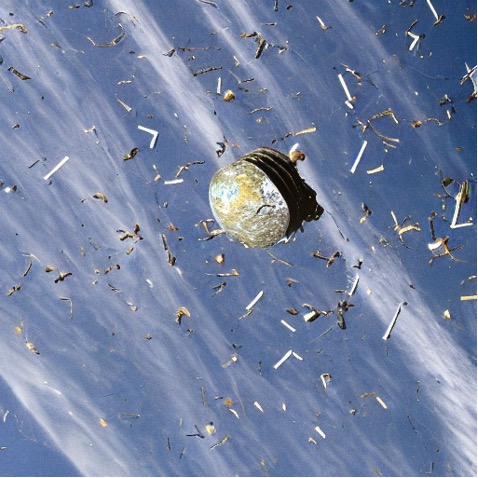
Floating above our atmosphere, over 35,600 objects larger than ten centimeters are estimated to be stuck in orbit.[3] These objects are known commonly as “space debris” and they pose risks to other satellites and humans on the ground.[4] Space debris is commonly depicted in movies and shows, such as Wall-E and Gravity, to show how dangerous and unsustainable the remnants of space travel can be.[5] Debris left in orbit below 600 kilometers typically falls back to Earth, while other debris will remain in orbit for thousands of years.[6] While extremely rare, the probability of a person being hit by space debris is low. For instance, Lottie Williams was struck in the shoulder by a piece of metal from a disintegrating rocket while walking through an Oklahoma park.[7] So, if a piece of debris does fall from orbit and strikes Earth, who is held accountable for the cost of the damages?
This article explores the current landscape of liability for damage caused by debris in space travel. Part II provides background on how the United Nations holds countries financially liable for damages under current international treaties. Part III discusses how the United States implements indemnification requirements against American corporate space travelers, as well as challenges that may arise from the global increase in commercial space travel. Finally, Part IV concludes that the U.N. should enact new comprehensive liability legislation that properly includes private space explorers.
II. Background
In 1972, the United Nations (“UN”) introduced a treaty known as the Convention on International Liability for Damage Caused by Space Objects (“Liability Convention”) as a means of expanding upon the liability rules introduced in the Outer Space Treaty of 1967.[8] The Outer Space Treaty is the cornerstone governing instrument that presides over space exploration and regulation.[9] The Outer Space Treaty operates on the governing principle that international co-operation and safety in the exploration and use of outer space benefits all people.[10] Under Article VII of the Outer Space Treaty, any country party that launches an object into outer space, including to the moon and other celestial bodies, is internationally liable for damage that the object may cause to another country, its property, or its people.[11] The Liability Convention was later introduced as a means to further specify how to redress damage caused by a country’s space objects, either on the surface of Earth or to any aircraft in space.[12]
Ratified by ninety-eight countries, the treaty imposes strict liability against any country that launched an object into space that causes damage on Earth or to any aircraft in flight.[13] The treaty classifies a “launching State” as any country that launches, procures a launched object, or whose facilities are used to launch a space object.[14]
If a space object is damaged while in flight or orbit, the launching state is not for accidental damages.[15] The treaty also provides for joint and several liability in certain circumstances, including where more than one country can be considered a launching State.[16] If more than one country is responsible for damages, the burden of compensation is apportioned equally between the parties at fault.[17] In a situation where two countries share joint liability, those countries have the right to present a claim for indemnification to the other participants in the joint launching.[18] If such countries reach an indemnity agreement, the financial obligation that they owe may be apportioned howsoever they agree, so long as it is not prejudicial to the country seeking damages.[19]
If a country is liable for damages, that country may be held financially responsible to deliver compensation for such damages.[20] Harmed countries may submit a claim for compensation against another country within one year of the date of damages, either through diplomatic channels or by requesting a non-interested country to present the claim.[21] These claims are overseen by the Claims Commission, which consists of three appointed members that decide the merits of the claims for compensation and the amount that should be paid. [22]
III. Discussion
While the Liability Convention may have successfully addressed the dangers of space debris in 1972, the nature of space exploration has evolved. The space industry has drastically shifted over the past two decades from government exclusivity to private actors commercializing space operations. With companies like SpaceX and Blue Origin emerging as modern leaders for space travel, the United Nations must adapt to current realities by including private actors in its legal liability framework.[23]
A glaring issue with the Liability Convention is that claims may only be brought by a country government against a State government.[24] The treaty does not assign responsibility to any non-State actor that may play a role in damages that stem from space travel debris.[25] The language of the Liability Convention is too narrowly tailored to hold non-State actors liable for damages they may cause. This aspect of the treaty continues to become outdated as corporations become increasingly involved in space travel.
The Dilemma of Corporate Space Travelers
Based on the current language of the Liability Convention, if there was a scenario where a company’s satellite caused sizeable damages on Earth, the country where they initiated flight would still be held absolutely liable as the “launching State,” though it may have had no ownership of the debris.[26] If such a situation were to play out, the launching State would be forced to pay reparations to the harmed country, and the space-traveling corporation would get off seemingly scot-free.[27] As a result, certain countries have taken their own legislative action to secure their immunity from incurring liability for damages on account of corporate-owned space debris.[28]
In 2020, the United States Federal Communications Commission (“FCC”) issued its most recent guidelines regarding space debris. In its “Mitigation of Orbital Debris in New Space Age” (“Mitigation”), the FCC adopted guidelines for all American government entities and all FCC licensee corporations that place satellites into orbit.[29] The Mitigation introduced a number of disclosure and maneuverability requirements for private entities, as well as clarified liability issues for space debris.[30] The Mitigation includes a rule that requires all FCC satellite licenses applicants to indemnify the United States against any costs associated with an international claim brought against the U.S..[31] By promulgating regulations regarding the commercial space industry, the United States government is promulgating domestic implementing legislation of the Liability Convention and other international space laws.[32]
These rules have been heavily opposed by numerous companies that engage in space operations. Boeing, EchoStar, SpaceX, Planet, Spire, Telesat, and others sought to have the rules changed so that they would not “excessively encumber” the spacecraft industry with regulations to prevent damage and costs with a remote likelihood of happening.[33] Yet, the FCC points out in the Mitigation that by enforcing an indemnification requirement, the U.S. not only fosters innovation and development, but also holds corporations accountable to protect the general public.[34] The fact that so many corporations openly resist assuming liability for their own dangerous space projects shows the importance of ensuring these corporations are held to the same standard as launching States.
The UN’s Next Steps
Half a century has passed, and the Liability Convention has remained relatively untouched.[35] Seeing how countries like the United States have implemented their own modern rules, the UN would be well-advised to follow suit and update its own space debris laws. A clear solution to fixing the Liability Convention is for the UN to introduce a new agreement that better encapsulates all entities that engage in space travel, not just signatory countries.
By introducing a newly amended version of the Liability Convention, the UN can fill this regulatory vacuum.[36] This new framework should include any State, corporation, or other entity that contributes to the space debris field in space. It should be the standard that by engaging in space affairs, a party subjects themselves to be found liable under international law and pay damages. A necessary step is to leave behind the term “launching State” and introduce a term that separates the physical location of the launch from the people that are sending objects into orbit. This could be done with a rewrite to broaden Article I’s definitions to include private actors.[37] Under the Liability Convention, any State may propose an amendment to the treaty that would be effective upon approval by a majority of the signatory parties.[38]
The UN may also benefit from abandoning the absolute liability standard for damage on Earth and in the atmosphere. Instead, the UN should move towards a uniform fault-based liability for all debris-related damages. Doing so would fall in line with the widely adopted tort laws of many countries.[39] The treaty already applies fault-based liability in instances where damages occur elsewhere than on the surface of Earth, so this would not be a novel concept for the UN. A fault-based standard would also allow the UN to assign culpability more accurately in situations where multiple entities, both countries and private actors, are responsible for damages. If fault-based liability is not a possibility, then absolute liability can still be a sufficient means of holding a private entity accountable if they are adequately included in the treaty’s language.
IV. Conclusion
As the risks of damage caused by space debris increases, it becomes increasingly more apparent that the United Nations’ system of laws governing liability for space debris is noticeably outdated in the new technologically advanced world. With a rise in commercial involvement in space travel, the Liability’s Convention framework must be changed to consider non-State actors and their potential complicity. Liability assigned solely to the “launching State” breeds possible legal disputes and challenges that will complicate an already complex area. Making such changes will not only further the Liability Convention’s mission of strengthening international co-operation in the field of outer space exploration, but also work to promote the common interest and safety of all humankind.[40]
[1] The Launch of Sputnik, 1957, U.S. Department of State (last visited Jan. 28, 2024),https://2001-2009.state.gov/r/pa/ho/time/lw/103729htm.
[2] Space debris by the numbers, The European Space Agency (Dec. 6, 2023),https://www.esa.int/Space_Safety/Space_Debris/Space_debris_by_the_numbers.
[3] Id.
[4] Id.
[5] Liza Furst, Space Film Junkie: Orbital Debris in Wall-E, Gravity, and Space Sweepers, Kall Morris Inc.(June 6, 2022)
https://www.kallmorris.com/columns/space-film-junkie-orbital-debris-in-wall-e-gravity-and-space-sweepers; WALL-E (Walt Disney Pictures 2008); Gravity (Warner Bros. Pictures 2013).
[6] Orbital Debris, NASA, (last visited Jan. 28, 2024), https://sma.nasa.gov/sma-disciplines/orbital-debris.
[7] Fabian Zander, What’s the risk of being hit by falling space debris?, BBC (Sep. 26, 2022, 9:00 AM), https://www.bbc.com/future/article/20220912-what-happens-to-space-debris-when-it-returns-to-earth.
[8]Convention on International Liability for Damage Caused by SpaceObjects, Mar. 29, 1972, 24 U.S.T. 2389, 961 U.N.T.S. 13810.
[9] Michael B. Runnels, Protecting Earth and Space Industries from Orbital Debris: Implementing the Outer Space Treaty to Fill the Regulatory Vacuum in the FCC’s Orbital Debris Guidelines, 60 Am. Bus. L.J. 175, 176 (2023).
[10] Id.
[11] Id.
[12] Liability Convention, supra note 8, at art. 2.
[13] Id.
[14] Id. at art. 1.
[15] Id. at art. 3.
[16] Id. at art. 5
[17] Id.
[18] Liability Convention, supra note 8, at art. 5.
[19] Id.
[20] Id. at art. 8.
[21] Id at art. 9-10.
[22] Id. at art. 15, 18.
[23] Beta Arays, Space Exploration: SpaceX, Blue Origin, and the New Space Race, Medium (Sep. 18, 2023)
[24] Liability Convention, supra note 8, at art. 8.
[25] Id. at art. 2.
[26] Jaymion Hendricks, Compensation for damage caused by space debris- just pie in the sky?, Africlaw, (Jun. 11, 2021) https://africlaw.com/2021/06/11/compensation-for-damage-caused-by-space-debris-just-pie-in-the-sky/.
[27] Id.
[28] Rachel Jewett, FCC Adopts Guidance on Orbital Debris Mitigation Rules, Via Satellite (Jan. 30, 2024) https://www.satellitetoday.com/government-military/2024/01/30/fcc-adopts-guidance-on-orbital-debris-mitigation-rules/.
[29] Mitigation of Orbital Debris in the New Space Age, 35 FCC Rcd. 4156 (2020).
[30] Id. at 4156.
[31] Id. at 4238.
[32] Runnels, supra note 9, at 179.
[33] Jeff Foust, FCC reaffirms orbital debris mitigation rule, Space News (January 26, 2024), https://spacenews.com/fcc-reaffirms-orbital-debris-mitigation-rules/.
[34] Mitigation, 35 FCC Rcd. at 4242.
[35] Hendricks supra note 26.
[36] Runnels supra note 9, at 228.
[37] Liability Convention, supra note 8, at art. 1.
[38] Id. at art 25.
[39] Mikitake Nakamura, Space Debris and Liability Schemes under International Law, Waseda Comp. L. Rev., 3 (2020).
[40] Liability Convention, supra note 8, at pmbl.
 The University of Cincinnati Intellectual Property and Computer Law Journal
Leave a comment