Magaly Taylor, Contributing Member 2023-2024
Publications Editor 2024-2025
Intellectual Property and Computer Law Journal
I. Introduction
Last year, an anonymous TikTok user, @ghostwriter977, admitted to using Artificial Intelligence (AI) to create a popular song, Heart on my Sleeve, using Drake and The Weeknd’s voice without their consent.[1] The song has since been removed;[2] however, the song received over 11,000,000 views among several videos in a few days and was streamed on multiple platforms thousands of times.[3] These actions are not rare and will continue unless legislative action is taken.
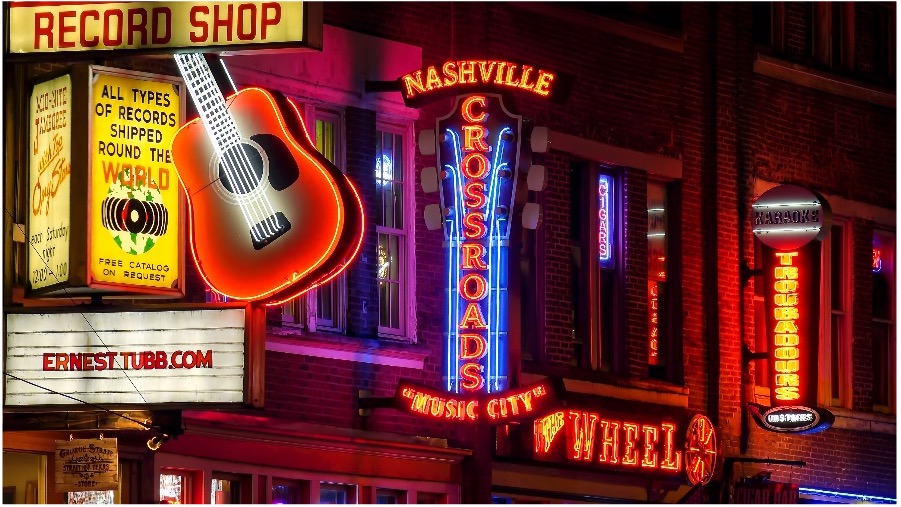
Tennessee’s music industry supports over 60,000 employees and hosts thousands of music events.[4] With growing AI concerns, Tennessee enacted legislation to protect musicians and entertainers from unauthorized AI theft on their sound and voice.[5] This Tennessee legislation primarily focuses on protecting the music industry.[6] This legislation protects individuals from deepfakes by adding voice as a protection. The legislation also includes protection from uncompensated endorsements, false creative works, or fabricated messages, whether it is a fabricated song, controversy statements, or political matters in which the artist does not agree with.[7] Thus, the legislation, The Ensuring Likeness Voice and Image Security Act (“ELVIS Act”), seeks to protect musicians and artists against AI misuse.[8]
This article will discuss the issue of unauthorized use of an individual’s voice using artificial intelligence tools in the music industry, and the challenges in enforcing new legislation. Part II explains the background in name image and likeness protection, the previous Tennessee law protecting personal rights, the new ELVIS Act that amends the prior law, and musicians’ federal protections. Part III discusses the defenses against the unauthorized use of AI on the voice generations and sound of artists, and the challenges of enforcing new regulations.
II. Background
The music industry has used computer technology for decades.[9] Producers and different artists have used computer technology, such as AI, to enhance their sound and edit music.[10] However, with the current advancement in AI technology, AI can quickly create original content using the sound of other artists, even without the artists consent.[11] As a result, AI users create a deepfake.[12] A deepfake can be used to misappropriate an artist’s image or likeness, or in this case, sound, for nefarious purposes, which could include unlawful commercial gain.[13] A person can be held liable for misusing a deepfake in a civil action through state or federal law.[14]
Personal Rights Protection Act of 1984
In 1984, Tennessee enacted the Personal Rights Protection Act, which recognizes a right of publicity.[15] The current law recognizes that a person has proprietary rights including their name, photograph, and the likeness of their image and that their rights may be assigned, licensed, and do not expire for a minimum of ten years after the individual’s death or more.[16] Likeness is defined as the use of an individual’s image for commercial purposes.[17]
A person who knowingly uses or infringes on another’s name, photograph, or likeness for commercial purposes without consent can be held liable in a civil action.[18] Further, a person can be held criminally liable and charged with a Class A misdemeanor for violation.[19] The individual harmed is entitled to recover up to three times the number of actual damages suffered.[20] The victim may also receive any profits attributable to the infringement, which are not directly a part of computing the actual damages.[21]
Lastly, there are exceptions to the Personal Rights Protection Act.[22] The current act allows fair use of an individual’s rights if a name, photograph, or likeness is connected with news, public affairs, or sports broadcast accounts.[23] Further, the Personal Rights Protection Act clarifies that use of an image itself does not constitute a use for advertising solely because it was used commercially.[24] When determining whether an individual infringed on a person’s likeness or fell under the fair use defense, a court must look at whether the use was directly connected with the commercial use for the purpose of advertising or soliciting.[25]
The Ensuring Likeness Voice and Image Security Act
In March 2024, Tennessee legislators enacted the ELVIS Act of 2024, an update to the Personal Rights Protection Act of 1984.[26] This act took effect on July 1, 2024,[27] and is intended to expand current protections of individuals, particularly musicians and performers, from unauthorized AI deepfakes replicating an individual’s voice.[28] This legislation is particularly important because of Tennessee’s prevalence in the music industry.[29]
The Elvis Act expands the current protections of individuals to include sound and voice.[30] The main change is that the act prohibits individuals from using another individual’s sound and voice.[31] The Elvis Act defines voice as “a sound. . . readily identifiable and attributable to a particular individual, regardless of whether the sound contains the actual voice or a simulation of the voice of the individual.”[32]
The ELVIS Act, similar to the Personal Rights Protection Act of 1984, has a section explaining when a voice can be used; however, unlike the Personal Rights Protection Act, the ELVIS Act expands the fair use defense.[33] The act defines fair use as relating to news, public affairs, or broadcasting, for purposes of a comment, satire, parody, incidental, or for an advertisement connected to a work previously described.[34]
III. Discussion
Defenses
The new law states that an individual may claim a fair use defense when an individual’s voice is used without permission.[35] Still, AI users may argue that the generated songs are not infringing on an individual’s voice because the songs may be deemed an “original” composition.[36] Additionally, in last year’s deepfake with Drake and The Weeknd, the author stated that Drake and The Weeknd were not involved in making the song and argued that listeners were not misled.[37] Universal Music Group, both Drake and the Weeknd’s record label, removed the song from streaming services.[38] Even if unsuccessful, AI users may attempt to claim they are not infringing on an artist’s voice if they release a statement showing that it is their work.
The ELVIS Act will go into effect in June, therefore, the scope of the fair use exception under the ELVIS Act has not been litigated.[39]
Enforcement
Social media platforms have a legal responsibility to prevent their services from harming artists and music producers.[40] However; this presents a unique challenge because AI work is easily accessible, and it may be difficult to distinguish the difference between original work and AI generated works. Further, social media makes it easy to distribute material, making the material more difficult to enforce.[41] Another challenge in enforcing these laws is that social media and other streaming services cannot identify whether an artist approved of the song before allowing the songs use in social media or streaming platforms.[42]
Further, artists have previously allowed—and even encouraged—the use of AI to create music using their voice, which is usually not the case for an artist’s image or likeness. For example, Grimes, a music artist, encouraged creators to use AI in song making using of her voice to make new music, and offered to split 50% royalties on successful hits.[43] There are potential profit for both parties in these cases, and although it is not standardly accepted to use an individual’s image or likeness, artists encouraging the use of their voice could make enforcement a challenge if they do not agree with the song or statements made using their voice.
IV. Conclusion
The ELVIS Act is a step towards protecting musicians—and other individuals—from unauthorized use of their voice. Although Tennessee plays a significant part of the music industry, more states need to protect an individual’s voice; infringing on an individual’s voice can be used for heinous purposes in addition to violating artists’ rights to compensation. It is essential that legislators adopt a standard at a federal level that supports and encourages protection for artists.
[1] Charisma Madarang, Elvis Act Signed Into Tennessee Law to Protect Musicians From AI Deepfakes, Rolling Stone (Mar. 21, 2024), https://www.rollingstone.com/music/music-news/elvis-act-tennessee-signed-ai-impersonation-1234992395/.
[2] Id.
[3] Samantha Murphy Kelly, The viral new ‘Drake’ and ‘Weeknd’ song is not what it seems, CNN, (Apr. 19, 2023), https://www.cnn.com/2023/04/19/tech/heart-on-sleeve-ai-drake-weeknd/index.html.
[4] Rebecca Rosman, Tennessee becomes the first state to protect musicians and other artists against AI, NPR, (Mar.22, 2024), https://www.npr.org/2024/03/22/1240114159/tennessee-protect-musicians-artists-ai.
[5] Id.
[6] Id.
[7] Eward D. Lanquist, et. al., New Legislation Proposed in Tennessee to Protect Against Deepfakes: ELVIS Act, Baker Donelson, (Jan. 17, 2024), https://www.bakerdonelson.com/new-legislation-proposed-in-tennessee-to-protect-against-deepfakes-elvis-act.
[8] Madarang, supra, note 1.
[9] Artificial Intelligence and Copyrights: Tennessee’s ELVIS Act Becomes Law, Armstrong Teasdale (Mar. 27, 2024), https://www.armstrongteasdale.com/thought-leadership/artificial-intelligence-and-copyrights-tennessees-elvis-act-becomes-law/.
[10] Id.
[11] Id.
[12] Lanquist, et. al., supra, note 7.
[13] Id.
[14] Id.
[15] Id.
[16] Tenn. Code Ann. § 47-25-1103 (2021).
[17] Tenn. Code Ann. § 47-25-1102 (2021).
[18] Tenn. Code Ann. § 47-25-1105 (2021).
[19] Id.
[20] Id.
[21] Tenn. Code Ann. § 47-25-1106.
[22] Tenn. Code Ann. § 47-25-1107.
[23] Id.
[24] Id.
[25] Id.
[26] H.B. 2091, 113th Gen. Assemb., Reg. Sess. (Tenn, 2024).
[27] Id.
[28] Madarang, supra, note 1.
[29] Lanquist, et. al., supra, note 7.
[30] H.B. 2091.
[31] Id.
[32] Id.
[33] Id.
[34] Id.
[35] Id.
[36] Kelly, supra, note 3.
[37] Id.
[38] Joe Coscarelli, An A.I. Hot of Fake ‘Drake’ and ‘The Weeknd’ Rattles the Music World, The New York Times, (Apr. 19, 2024), https://www.nytimes.com/2023/04/19/arts/music/ai-drake-the-weeknd-fake.html.
[39] Armstrong Teasdale, supra, note 9.
[40] Kelly, supra, note 3.
[41] Id.
[42] Id.
[43] Madarang, supra, note 1.
 The University of Cincinnati Intellectual Property and Computer Law Journal
Leave a comment