Jen Neal, Contributing Member 2024-2025
Intellectual Property and Computer Law Journal
I. Introduction
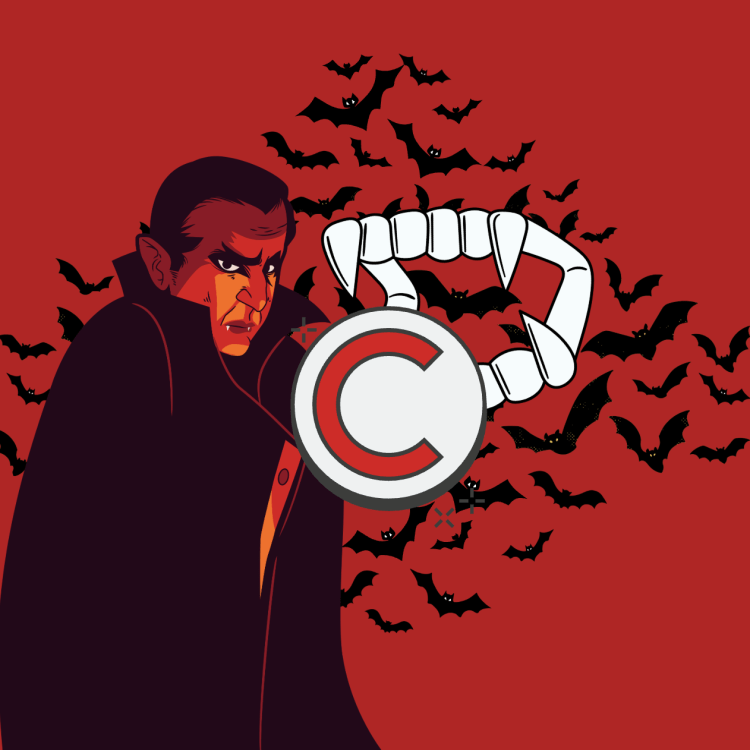
This blog explores the many instances of copyright ownership assertion over vampires in popular culture and media. Part II provides background on the origins and depictions of vampires. Part III describes various forms of ownership of vampire depiction and discuss how such ownership has been asserted. Part IV concludes by arguing that the classic vampire tropes are so prominent in the common sphere of thought that it would be unjust to allow copyright ownership of vampire tropes.
II. Background
Vampires have been a staple of classic horror monsters for over a century. Various creators of media, like authors, directors and other artists, have evoked the archetypal bloodsucking seductors, each taking aspects of former works to create their own version of a vampire. The concept of a vampire is much like any other monster originating from historical legends. The origins of vampire stories stem from ancient Eastern European folklore.[1] The earliest written reference to a vampire is found in an Old Russian text written in 1047, but the word “vampire” was not first written until 1725.[2] As wars of conquest raged in Eastern Europe around the mid-18th century, Western European soldiers heard terrifying stories from the local Slavic people about bodies rising from the dead to terrorize communities.[3] The story told of locals who exhumed a body suspected of reanimating, staked the body in the heart, and then cremated it for good measure.[4] For the local Slavic people, this was the required method to kill the monster and prevent them from rising again.[5]
The Western European soldiers spread the Slavic legends across Europe, resulting in the a widespread fear of monsters called vampires.[6] As the legends spread, vampires began appearing in European literature and poetry.[7] These folklore stories and legends depicted the stereotypical bloodsucking ghoul and transformed the monster through a romanticized angle of a wealthy, seductive, and polished entity.[8] Though many believe the origins of the romanticized vampire began with Brahm Stoker’s Dracula, a similar archetype was written almost 70 years prior.[9]
Many are familiar with the fateful writing contest in Geneva, Switzerland, in 1816, which spurned Mary Shelley to write the classic Frankenstein.[10] It is less widely known that in the same writing contest, John William Polidori took a fragment of Lord Byron’s story, The Vampyre, about a dying man who vows to come back from the dead and visit his friend.[11] This story introduces a wealthy, mysterious character, Lord Ruthven, who seduces women and drains them of their blood.[12] Lord Ruthven also returns from the grave to inevitably marry the protagonist’s sister, inherit their family title, and subsequently kill her.[13]
Almost 70 years later, Dracula is published, further popularizing many of the ideas of the wealthy, seductive, and mysterious vampire.[14] From this novel, various versions of the story were introduced in film. In 1921, the silent film, Drakula halála, was released in theaters, becoming the first film to feature the character of Dracula, but tells a different story than the original novel.[15] The following year, a notable first adaptation of the novel was released in the form of the German silent film Nosferatu.[16] Nosferatu was famously an unauthorized and unlicensed adaptation of the original novel, causing Stoker’s widow to bring a copyright infringement action against the film’s producers.[17] As a result of the settlement, the German court ordered all copies of Nosferatu to be destroyed.[18] Prior to the destruction order, a few copies of the film had been distributed to the United States, allowing the film to live on and become a cult classic.[19]
About ten years later, in 1931, Universal released the first of its’ now classic monster movies, Dracula.[20] Universal’s Dracula cast Bela Lugosi, a Hungarian actor, as Count Dracula.[21] Lugosi had previously played Dracula in a theatrical production of the novel in 1927.[22] Lugosi’s Hungarian accent played into the origins of vampire legends and penned the classic voice and mannerisms of Dracula that still exist in media today.[23]
Following the release of various Universal monsters movies, Hammer Film Productions began creating a new, dramatic, and pulpy movie monster standard in the 1950s.[24] Because Hammer Films’ movies were tackling many of the same iconic monsters that Universal had already released, Hammer had to delicately dance around Universal’s copyright protections.[25] As a result, Hammer and Universal ironed out lengthy legal agreement to allow Hammer to produce their own version of a Dracula film.[26]
III. Discussion
The archetype of the romanticized vampire has become so common in popular culture and media that the idea should not be awarded copyright protection. The story of The Vampyre predates Dracula by almost 70 years, yet the latter is still considered the archetypal modern vampire story.[27] Since then, many different variations of vampires have been introduced into popular culture and media, few deviating from the archetypal characteristics that define the trope.
The stories that created the stereotypical vampire we imagine today each borrow from stories before them. These stories originated with spoken cultural legends that terrified creatives to make these legends into characters. The vampires transformed from ghastly ghouls into seductive nobles.
The origin of the romanticized vampire can be traced to Polidori’s story.[28] Despite this, Dracula stands out as the icon of the romantic vampire. Both Polidori’s Lord Ruthven and Stoker’s Count Dracula are wealthy members of the nobility, with Ruthven becoming an Earl at the end of the story.[29] Further, both vampires are known to seduce women with their charm and mystery, killing the women, and draining their blood.[30]
Clearly, Stoker borrowed some ideas from Polidori’s characterization of a vampire. In modern American copyright law, copyrighted works are protected for the life of the creator, plus seventy years.[31] Had Polidori copyrighted The Vampyre, Stoker may never have been able to release Dracula because of the distinct similarities in their vampire characters. In reality, Polidori was British, and copyright law in Britain at the time provided little protection in terms of time. The British Copyright Act of 1814 provided protection for the author’s life, plus 25 years.[32] Polidori died in 1825, meaning his work would become public domain almost 50 years before Dracula was written. Copyright protection for The Vampyre would not have prevented Stoker from creating and releasing his own vampire story.
Stoker was very careful in obtaining copyright protections for his own work.[33] Even prior to publishing Dracula, Stoker arranged a dramatic reading of the novel in the Lyceum Theatre to secure the stage rights.[34] In 1912, Stoker died, leaving his widow, Florence, to manage his estate and the copyright ownership of Dracula.[35] Florence had to utilize the copyright protections when Nosferatu was released.
The copyright infringement between Nosferatu and Dracula was very apparent considering the multitude of similarities between the original story and the new film.[36] Both the original novel and the 1922 film follow essentially the same plot.[37] In both works, a young man is sent far into Eastern Europe to assist a local noble in purchasing a home in London.[38] The noble ends up being a dangerous vampire.[39] The visit almost kills the young man, but he survives to return home to join his wife and others in the hunt of the dangerous Count who has bought property in their city.[40] Each story ends with the death of the vampire, although the endings are very different.[41] Nosferatu notably introduces a weakness to sunlight as new staple to vampiric lore.[42]
Despite the various differences and innovations introduced by Nosferatu, the starkly similar plots drew the attention of Stoker’s widow who brought a copyright infringement action against the producers of the film.[43] After seven years of back-and-forth legal battle, Stoker succeeded with her infringement claim.[44] Very little detail remains to give context to the legal proceedings other than the notable court mandated destruction of the film, which was famously unsuccessful.[45] The surviving copies meant that the aspects Nosferatu introduced to the vampire genre lived on to permeate modern culture, including in the children’s cartoon Spongebob Squarepants,[46] and most recently the critically acclaimed 2024 remake of the film itself.[47]
The idea of an order of destruction of property may seem as if it were just a legal norm from a different time and country, but this is not the case. The copyright infringement litigation surrounding the controversy of Nosferatu and Dracula was undertaken in German courts with both British and German attorneys.[48] The destruction of a film is not unique to those European courts or that certain time period. Modern American copyright law provides court ordered destruction of all copies of the infringing materials as a possible remedy.[49] If court ordered destruction of all copies of Nosferatu had been successful, many of the later iterations of romantic vampires would never have such a deadly aversion to sunlight.
Shortly after the conclusion of the copyright infringement battle, Stoker sold the Dracula screen rights to Universal Studios for $40,000, which amounts to almost $600,000 today.[50] In 1931, Universal released Dracula, the first screen adaptation of the film with sound.[51] Lugosi, the leading man in Universal’s Dracula, allegedly spoke little English and his pervasive Hungarian accent added an iconic flair to the romantic vampire trope. The strong accent and Lugosi’s theatrical performance became a fixture of subsequent portrayals of vampires, from further film adaptations of the Dracula novel[52] to “The Count” on the preschool classic, Sesame Street.[53]
When Universal cast Lugosi, his contract provided that Universal “shall have the right to … produce, reproduce, transmit, exhibit, distribute, and exploit … any and all of the artist’s acts, poses, plays, and appearances.”[54] This grant of rights also included Lugosi’s voice in the film, essentially granting Universal the rights to his portrayal of Count Dracula, including his accent.[55]
After Lugosi died in 1956, Universal continued to profit of his likeness as Count Dracula.[56] As a result, Lugosi’s widow and surviving son brought legal action against Universal, alleging that Universal appropriated licensing rights of Lugosi’s portrayal of Count Dracula and his family retained ownership of those rights.[57] The trial court determined that the licensing rights Lugosi granted to Universal only extended to his portrayal of Count Dracula in the film, but did not cover separate merchandising.[58] The appellate court stated that in Lugosi’s life, he had a right “of value” to create in his name or likeness, and he could also protect that right from others aiming to profit by a suit of injunction or damages.[59] Lugosi’s family asserted that such right “of value” was inherited by them upon his death.[60] The court disagreed and held that the right to exploit one’s likeness expires upon their death.[61]
The result of this case was a win for Universal and a loss to the Lugosi’s surviving family members. Lugosi’s family was left with concerns of their dead relative would be portrayed and who would profit off such portrayal. The dissent in Lugosi asserts that a person’s right to exploit their likeness should be treated as a property right and be descendible after death.[62] The extensive litigation over the simple portrayal of the character of Count Dracula speaks to the value Lugosi added to the role and the genre itself.
About thirty years after the original release of Universal’s Dracula, Hammer Films emerged as a new contender within the Hollywood horror realm.[63] One of the first iconic Hammer Horror films was The Curse of Frankenstein, an adaptation of the Mary Shelley novel.[64] Despite Shelley’s novel being public domain in the United States, Hammer faced its first copyright controversy with Universal because of their 1939 adaptation, Son of Frankenstein.[65] Although Universal was unable to obtain exclusive copyright protection to Shelley’s work, they were able to protect the iconic look of their leading actor, Boris Karloff’s, Frankenstein monster.[66] As such, Universal retains copyright protections of monsters including all elements of green skin, a flat top head, a scar on the forehead, bolts on the neck, and a protruding forehead.[67] Because of these protections, Hammer had to be very intentional and careful with their portrayal of Frankenstein’s monster, only utilizing green skin and a scar on the forehead.[68]
Following Hammer’s success with The Curse of Frankenstein, Hammer set their sights on another iconic movie monster: Count Dracula.[69] Hammer had to especially vigilant in making a Dracula movie as Universal retained the film rights to the novel.[70] As a result, Hammer reached out to Universal and the two came to a legal agreement, over 80 pages long, for the licensing rights of Count Dracula.[71] In 1958, Hammer’s Dracula was released and later renamed Horror of Dracula to avoid confusion with the Universal film.[72]
Universal’s grasp upon the screen rights of Dracula made adaptations of the novel particularly difficult. The story of Dracula was over 50 years old at this point and the many adaptations made it into a classic monster trope. More recently, with the Lugosi litigation, the trial court found that Count Dracula character, from the novel itself, is in the public domain in the United States, making adaptations more accessible.[73] Though some of the classic tropes are public domain, creatives continue to expand and add their own flair to the genre – like making vampires shimmer in the sun, rather than ignite.[74]
IV. Conclusion
Though certain aspects of the vampire trope are now public domain, it should stand that iconic aspects of the romantic vampire character should not be awarded intellectual property protections. Depictions of vampires have had an extensive history of intellectual property ownership conflicts, but the idea of a vampire has become a pervasive part of modern culture that should exclusively remain in the public domain.
[1] Bella Isaacs-Thomas, How vampire lore emerged from shadowy medical mysteries, PBS News (Oct. 31, 2023). https://www.pbs.org/newshour/science/how-vampire-lore-emerged-from-shadowy-medical-mysteries [https://perma.cc/RCX3-J8QC].
[2] Henry R. Cooper, Slavic Scriptures 219 (2003); Nick Groom, The Vampire 28 (2018).
[3] Id.
[4] Id.
[5] Id.
[6] Issacs-Thomas, supra note 1.
[7] Id.
[8] See Groom, supra note 2.
[9] Brahm Stoker, Dracula (1897); John William Polidori, et al., The Vampyre (1819).
[10] See Stacy Condrat, How a Friendly Writing Contest Resulting in Three Literary Classics, Mental Floss (Jun. 23, 2011) https://www.mentalfloss.com/article/28063/how-friendly-writing-contest-resulted-three-literary-classics [https://perma.cc/5GS5-288X].
[11] Id.
[12] Polidori, supra note 8.
[13] Id.
[14] See Stoker, supra note 8.
[15] Adrienne Tyler, A 103-Year-Old Lost Film was Actually the First Dracula Movie, Not the Movie People Think is the First, Screen Rant (Feb. 4, 2024), https://screenrant.com/nosferatu-not-first-dracula-adaptation-lost-movie/ [https://perma.cc/6CEG-FPXA].
[16] Id.
[17] Derek Scally, Nosferatu and the fangs of copyright infringement, Irish Times (Mar. 5, 2022), https://www.irishtimes.com/culture/film/nosferatu-and-the-fangs-of-copyright-infringement-1.4814233 [https://perma.cc/N8VE-GYCB].
[18] Id.
[19] Id.
[20] Brandon Swanson, Four Decades of Fearsome Fun: A Brief History of Universal Monsters, Ent. Earth News (Last visited Feb. 24, 2025), https://www.entertainmentearth.com/news/history-universal-monsters/ [https://perma.cc/EYT3-8T6B].
[21] Roger Ebert, Dracula, Roger Ebert.com (Sept. 19, 1999), https://www.rogerebert.com/reviews/great-movie-dracula-1931 [https://perma.cc/XLY6-E5NZ].
[22] Id.
[23] See Przwmysław Bociaga, The Secret to Being a Convincing Vampire, 3 Seas Europe (Oct. 24, 2024), https://3seaseurope.com/the-secret-to-being-a-convincing-vampire-hint-accent-matters/ [https://perma.cc/67UM-3NVG].
[24] Allan Major, Universal Horror vs. Hammer Horror: Battle of the Studios, Horror Movies Reviewed (May 31, 2024), https://www.horrormoviesreviewed.com/post/universal-horror-vs-hammer-horror-battle-of-the-horror-studios [https://perma.cc/A8A5-AG7D].
[25] See Jonathan Bailey, How Universal Re-Copyrighted Frankenstein’s Monster, Plagiarism Today (Oct. 24, 2011), https://www.plagiarismtoday.com/2011/10/24/how-universal-re-copyrighted-frankensteins-monster/ [https://perma.cc/U9K7-XUV9].
[26] Wayne Kinsey, Hammer Films: the Bray Studio years, 67 (2002).
[27] See Polidori, supra note 8; See Stoker, supra note 8; See Isaacs-Thomas, supra note 1.
[28] See Polidori, supra note 8.
[29] Id.; Stoker, supra note 8.
[30] Id.
[31] How Long Does Copyright Protection Last? U.S. Copyright Office (Last visited Feb. 24, 2025).
[32] Phillip V. Allingham, Nineteenth-Century British and American Copyright Law, Victorian Web (Aug. 10, 2013) https://victorianweb.org/authors/dickens/pva/pva74.html [https://perma.cc/42XL-7MGJ].
[33] Scally, supra note 16.
[34] Id.
[35] Id.
[36] See Stoker, supra note 8; See Nosferatu: A Symphony of Horror (Prana Films 1922).
[37] Id.
[38] Id.
[39] Id.
[40] Id.
[41] Id.
[42] Nosferatu, supra note 25.
[43] Scally, supra note 16.
[44] Id.
[45] Id.
[46] Spongebob Squarepants: Graveyard Shift (Nickelodeon television broadcast Mar. 12, 2002).
[47] Nosferatu (Focus Features, 2024).
[48] Scally, supra note 16.
[49] 17 U.S.C § 503(b).
[50] Scally, supra note 16.
[51] See Id.
[52] Bram Stoker’s Dracula (Columbia Pictures 1992).
[53] Sesame Street (PBS 1972).
[54] Lugosi v. Universal Pictures, 25 Cal. 3d 813, 603 P.2d 425 (1979).
[55] Id.
[56] Id.
[57] Id.
[58] Id.
[59] Lugosi, 25 Cal. 3d at 821.
[60] Id.
[61] Id.
[62] Id.
[63] See Major, supra note 23.
[64] The Curse of Frankenstein (Hammer Film Productions 1957).
[65] Bailey, supra note 24.
[66] Id.
[67] Id.
[68] Id.
[69] See Kinsey, supra note 25.
[70] See Scally, supra note 16.
[71] Kinsey, supra note 25.
[72] Id.
[73] Lugosi, 25 Cal. 3d at 821.
[74] See Stephanie Meyer, Twilight (2005).
 The University of Cincinnati Intellectual Property and Computer Law Journal
Leave a comment