Wil Schuehler, Associate Member 2025-2026
Intellectual Property and Computer Law Journal
I. Introduction
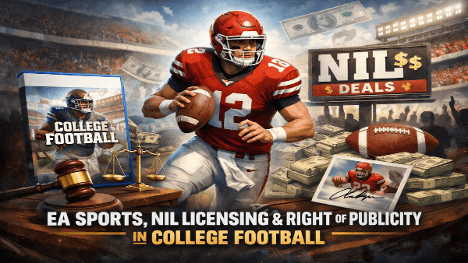
On July 19th, 2024, Electronic Arts Sports (EA Sports) released the video game titled College Football 25 (CFB 25), ending an eleven-year production hiatus.[1] College Football 25’ went on to become the second best-selling game of the year, but the legal and economic developments enabling its return are less widely understood.[2] This blog argues that the revival of EA Sports’ college football franchise was made possible by recent shifts in NIL law and antitrust jurisprudence, but that the current group licensing structure systematically undervalues student-athlete publicity rights. Part II examines the legal backdrop that forced the franchise’s suspension and later enabled its revival, including key antitrust and right of publicity cases. Part III discusses the structural inefficiencies of current NIL group licensing regimes, focusing on compensation disparities for student athletes and collective bargaining limitations. Part IV concludes by recognizing the need for reform within the field and provides a solution.
II. Background: Legal Landscape
Why EA Sports College Football Was Abandoned
EA Sports stopped producing its NCAA Football game in 2013.[3] The end of the game stems from the case O’Bannon v. NCAA, an antitrust class-action that named the NCAA, EA Sports, and the Collegiate Licensing Company (CLC) as co-defendants.[4] O’Bannon argued that the defendants violated Section 1 of the Sherman Act by preventing student athletes from being compensated for the commercial use of their NIL.[5] EA Sports and CLC settled, and the Ninth Circuit held the NCAA must allow schools to provide up to the cost of attendance to their student athletes.[6] Importantly, the O’Bannon decision did not prohibit EA Sports from compensating student athletes for their NIL. Instead, it highlighted the NCAA’s historical restrictions allow student athletes to profit commercially in any way while in school, essentially limiting compensation to education-related benefits.[7]
O’Bannon was not the only legal challenge facing the NCAA Football franchise.[8] Around the same time, NCAA former players sued alleging right of publicity violations. In Keller v. Elec. Arts, Inc. and Hart v. Elec. Arts, Inc. the courts held that the video game franchise’s depiction of the athletes within the game violated their right of publicity.[9] In fact, the NCAA, who provided EA Sports with a license to use its own NIL, declined to renew a contract with EA following these cases and cited litigation costs and business decisions as the reason.[10] Without the licensing to use NCAA branding and increased susceptibility to litigation, EA Sports discontinued the franchise.[11]
The Right of Publicity
The legal doctrine underlying these disputes is the right of publicity.[12] The right of publicity is an intellectual property right that protects against the misappropriation of a person’s NIL for commercial benefit.[13] Interestingly, there is no unified federal right of publicity.[14] Instead, the doctrine is governed by a patchwork of state statutes and common law.[15] A key limitation on the right of publicity is the First Amendment involving expressive works.[16] While video games enjoy the freedom of expression, they must pass the transformative use test as an affirmative defense to a right of publicity claim.[17]
One case that illustrates the right of publicity is Keller v. Elec. Arts, Inc. where Arizona State University quarterback, Samuel Keller brought a right of publicity suit against EA Sports. The EA Sports’ video game utilized Samuel Keller’s football jersey number, physical characteristics, and biographical information.[18] The court ruled that EA’s use of Keller’s NIL in the NCAA College Football video game did not qualify under transformative use and violated his right of publicity.[19]
Further, Hart v. Elec. Arts, Inc. supports Keller with a near identical holding.[20] In Hart, former Rutgers University quarterback, Ryan Hart, sued EA for right of publicity.[21] The Third Circuit ultimately held that EA’s affirmative defense would not work as the game developer did not pass the transformative test necessary.[22] Together, Keller and Hart established that realistic sports simulations are particularly vulnerable to right of publicity claims.
How EA College Football Was Revived
Nearly a decade after the franchise was discontinued, a series of legal developments dramatically altered the landscape of college athlete compensation.[23] Notably, in NCAA v. Alston, 594 U.S. 69, 73 (2021), the U.S. Supreme court issued a unanimous decision holding that limiting certain education-related benefits schools can provide student athletes violated Section 1 of the Sherman Antitrust Act.[24] Further, the concurring opinion by Justice Kavanaugh highlighted the questionable nature of the NCAA making billions in revenue on college sports yet not paying their student athletes.[25] While this decision did not say anything specifically about NIL, it significantly impacted the regulatory model chosen by the NCAA.[26] In response to the Supreme Court case, the NCAA adopted an Interim NIL Policy that allowed student athletes to benefit financially from their NIL.[27]
Furthermore, 32 states passed NIL legislation protecting college athletes’ rights to earn NIL compensation.[28] Among the states to pass NIL legislation, California was the first in 2019.[29] The act, “Fair to Pay to Play”, prohibited the NCAA or member schools from punishing student-athletes who earn NIL compensation.[30] However, it along with the other states would not be enacted until 2022 or 2023.[31] These developments opened the door for EA Sports to finally continue the College Football videogame franchise.
III. Discussion
The Compensation Disparity
One issue frequently highlighted in the revived EA Sports College Football game is the disparity between student athlete compensation and the commercial value generated by the game.[32] After the revival, EA Sports turned to OneTeam Partners (a group licensing company) who utilized an app to allow college football players to sign up to be portrayed in the game in exchange for $600 and a free EA sports College Football game.[33] This may seem acceptable, but to better recognize the disparity it is helpful to inspect some statistics. On one hand, EA Sports spent approximately $6.5 million to pay over 10,000 college football players that opted in to the game (CFB 25).[34] On the other hand, EA Sports reported to have made $500 million in less than fourteen days from release (CFB 25).[35] Additionally, EA Sports considered $150 million in revenue to be a success which further highlights just how high the commercial value was/is in reality.[36]
Another factor contributing to the compensation disparity is the lack of royalties, which is considered common practice in the sports video game landscape.[37] Student athletes not being granted royalties cannot solely be attributed to EA Sports, but rather the NCAA’s rules and regulations.[38] For example, the NBA has the National Basketball Players Association (NBPA) who represent the players in collective bargaining, agent regulation, and group licensing.[39] The NBPA allows the NBA to license the league players NIL to the video game NBA 2K.[40] While most deals are shrouded, in 2019 the player union agreed to a $1.1 billion licensing deal with NBA 2K.[41] Considering this, it is clear that without a player union to negotiate terms on their behalf along with the lack royalties, college football student athletes are missing out on potential compensation.[42]
Moreover, there is a disparity in compensation for more popular players that are featured/marketed more within the game.[43] No matter a player’s popularity, performance, or usage in the CFB game, they will receive the same $600 amount and a free copy of the game.[44] This uniformity fails to reflect the varying degrees of commercial value associated with individual athletes.
Structural Limitations of College Group Licensing
Compounding the compensation disparity issue are the structural limitations presented in college athletics NIL licensing. Usually, player unions negotiate terms for group licensing that combines the use of multiple athletes’ NIL.[45] For example, EA Sports for games such as Madden use group licensing deals to use the NIL of multiple athletes for the video game.[46] However, the NCAA prohibits players from unionizing which prevents the college athletes from being able to negotiate a group licensing deal.[47] If student athletes were able to unionize/collective bargain, they could potentially negotiate group licensing agreements that include revenue sharing and royalties similar to the NFL and NBA.[48]
Nevertheless, even if student athletes were permitted to unionize there would be significant hurdles. First, there are 136 Football Bowl Subdivision teams with over 11,000 players.[49] These numbers are vastly larger than the 1,700 or 450 players in the NFL and NBA respectively.[50] To create one union for a group so large would be incredibly difficult with diverging interests.[51] Second, schools are anticipating potential unionization efforts involving only their athletes, meaning the NCAA could have as many as one union per participating school.[52] Third, state labor laws would create a patchwork legal landscape, making the sustainment of a collective bargaining unit almost impossible.[53]
These structural limitations illustrate that the absence of unionization/collective bargaining is not only policy dependent but also limited as a result of logistical challenges.
Proposed Reforms
Although the current NIL licensing structure allowed the revival of EA Sports College Football, it may not be the most equitable. One possible reform option would be to create a tiered compensation structure. As mentioned above, originally all student athletes were compensated equally despite prominence, performance, or marketability.[54] The tiered model could be implemented to increase base compensation per player when NIL usage is at a higher level. This type of structure could better reflect the commercial value associated with individual student athletes, while maintaining feasibility. This approach could be done by tracking in-game prominence metrics, which are already used for university licensing, and tying heavier usage to additional payouts.[55]
Another possible reform involves the distribution of NIL royalties from universities to their student athletes. Currently, NCAA universities license their NIL rights with EA Sports to be paid on a tiered model.[56] There are tiers one through four, with tier one receiving a minimum royalty of $100K and tier four receiving a minimum of close to $10K.[57] Further, royalty payment proportions were tied to the amount of usage a universities team or players were used in-game.[58] In contrast, participating athletes receive the base fee and did not share in the revenue growth.[59] Allowing universities to allocate a portion of their licensing royalties from EA Sports to their players could create a more balanced compensation structure. While universities and the NCAA may resist because of administrative complexity, this approach is practical without unionization or significant reform as universities already manage licensing revenue.
However, it is also important to recognize that reform may not be needed. As mentioned previously, EA Sports allows college athletes to opt-in to the video game.[60] Inherently, this shows the voluntariness on behalf of the players and possibly shows that players are content with the payout received.
IV. Conclusion
The current structure of group licensing and the ensuing compensation disparity involved in the college sports video game landscape systematically undervalues student-athlete publicity rights and fails to reflect the commercial value these athletes generate. Video game developers should implement tiered compensation models or universities should distribute royalties derived from university NIL licensing. These approaches could create more balance between commercial value and compensation and serve as a model for future NIL legislation.
[1] Jordan Mendoza, When Does EA Sports College Football 25 Come Out? Some Will Get to Play on Monday, (last visited Mar. 21, 2026), https://www.usatoday.com/story/sports/ncaaf/2024/07/15/ea-sports-college-football-25-come-out-release-time/74359831007/ [https://perma.cc/W8PD-TLUZ].
[2] Fandom, Best-Selling Premium Games, (last visited March 22, 2026), https://vgsales.fandom.com/wiki/2024#:~:text=%22Black%20Ops%206%20Was%202024’s,GameSpot [perma error].
[3] Kevin Sweeney, Why Did EA Sports Stop Making NCAA Football Video Games?, (Feb. 2, 2021), https://www.si.com/college/2021/02/02/ncaa-football-ea-sports-stopped-making-games [https://perma.cc/DQL9-C9HR].
[4] Id.
[5] O’Bannon v. NCAA, 802 F.3d 1049, 1075 (9th Cir. 2015).
[6] Id. at 1079.
[7] Id.
[8] Id.
[9] Keller v. Elec. Arts Inc. (In re NCAA Student-Athlete Name & Likeness Licensing Litig.), 724 F.3d 1268, 1284 (9th Cir. 2013); Hart v. Elec. Arts, Inc., 717 F.3d 141, 170 (3d Cir. 2013).
[10] SteveBerkowitz, EA Drops Football in ’14, Settles Cases as NCAA Fights, (last visited March 22, 2026), https://eu.usatoday.com/story/sports/college/2013/09/26/ea-sports-ncaa-13-video-game-keller-obannon/2878307/ [https://perma.cc/5CAE-JBER].
[11] Id.
[12] Keller, supra note 9; Hart, supra note 9.
[13] International Trademark Association, Right of Publicity, (last visited March 21, 2026), https://www.inta.org/topics/right-of-publicity/#:~:text=The%20right%20of%20publicity%20is%20an%20intellectual,misappropriation%20of%20these%20items%20for%20commercial%20benefit [https://perma.cc/ND3U-ZUBN].
[14] Id.
[15] Id.
[16] Tyler S. Woods, Professional Athletes & Video Games: An Analysis of the Transformative Use Test, Arizona State L. J., 2021 https://arizonastatelawjournal.org/2020/02/25/professional-athletes-video-games-an-analysis-of-the-transformative-use-test/ [https://perma.cc/3GJL-K9UF].
[17] Id.
[18] Keller, supra note 9.
[19] Id.
[20] Hart, supra note 9.
[21] Dan Rogers, EA Strikes Out in Right of Publicity Case, (August 1, 2013), https://www.gamedeveloper.com/business/ea-strikes-out-in-right-of-publicity-case [https://perma.cc/VRY9-MAQY].
[22] Id.
[23] Amanda Christovich, The Road to the Return of ‘EA Sports College Football, (July 20, 2024), https://frontofficesports.com/newsletter/the-return-of-ea-college-football/ [https://perma.cc/VWF9-Y2TF].
[24] Husch Blackwell, NCAA v. Alston: Five Key Takeaways, (June 22, 2021), https://www.huschblackwell.com/newsandinsights/ncaa-v-alston-five-key-takeaways [https://perma.cc/U83S-Y3P4].
[25] NCAA v. Alston, 594 U.S. 69, 110, 141 S. Ct. 2141, 2168 (2021).
[26] Id.
[27] Anthony M. Dalimonte, NIL Timeline: The Events That Transformed College Sports, (April 21, 2023). https://www.fosterswift.com/newsroom/publications/timeline-NIL-cases-transform-college-sports [https://perma.cc/B657-B6JL].
[28] Mark Butscha Jr., Trouble in the Huddle – Uncertainty and Opportunity with the NCAA’s NIL Rules, (March 28, 2024), https://www.thompsonhine.com/insights/trouble-in-the-huddle-uncertainty-and-opportunity-with-the-ncaas-nil-rules/ [https://perma.cc/WV2H-K62H].
[29] Dalimonte, supra note 27.
[30] Id.
[31] Id.
[32] Christovich, supra note 23.
[33] Id.
[34] Sam Gutelle, EA Is Bringing Back A Beloved College Football Video Game (and Paying $6 Million In NIL Money To Do It), (March 8, 2024), https://www.tubefilter.com/2024/03/08/ea-sports-college-football-name-image-likeness-nil-video-game-deals/#:~:text=The%20advent%20of%20the%20NIL,$6%20million%20and%20$7%20million [https://perma.cc/9E3U-NT3X].
[35] James Parks, EA Sports College Football 25 Makes Half-Billion Dollars in 2 Weeks: Insider, (July 31, 2024), https://www.si.com/fannation/college/cfb-hq/news/ea-sports-college-football-25-video-game-revenue [https://perma.cc/J6NG-9UVU].
[36] Id.
[37] Amanda Christovich, ‘Treated Like Children’: College Players Offered $600, No Royalties, (February 22, 2024), https://frontofficesports.com/treated-like-children-college-players-offered-600-no-royalties/ [https://perma.cc/W7LP-SZJE].
[38] NCAA Bylaw 12, (last visited March 22, 2026), https://web3.ncaa.org/lsdbi/search/bylawView?id=8740 [https://perma.cc/3LMR-FQTP].
[39] Jason Owens, NBA, Player’s Union Agree to Reported $1.1 B Licensing Deal For ‘NBA 2K’ Video Game, (January 16, 2019), https://sports.yahoo.com/nba-players-union [https://perma.cc/T5GE-EUAY].
[40] Id.
[41] Id.
[42] Dalimonte, supra note 27.
[43] Alston at 2168.
[44] Dalimonte, supra note 27.
[45] Husch Blackwell, supra note 24.
[46] Eben Novy-Williams & Scott Soshnick, NFL’S ‘Madden’ Video Game Deal Worth $1.6 Billion to Leage, Players, (June 29, 2020) https://www.sportico.com/business/sales/2020/nfls-madden-video-game-deal-worth-1-6-billion-to-league-players-298/ [https://perma.cc/VPN7-WXG3].
[47] Christovich, supra note 23.
[48] Amanda Christovich, Players Seek Better Deal With EA Sports College Football, (February 13, 2025), https://frontofficesports.com/players-seek-better-deal-with-ea-sports-college-football/ [https://perma.cc/XP6Q-CHHU].
[49] Billy Tucker, Top 2026 Newcomer For Every Big 12 Team, (March 18, 2026), https://www.espn.com/college-football/story/_/id/48231474/2026-college-football-newcomers-coaches-grade-big-12-teams [https://perma.cc/WH2P-B7NQ].
[50] William Hall & Sidney Lewis, New Report Illustrates Complications With College Athlete Unionization, (March 9, 2026), https://www.joneswalker.com/en/insights/blogs/perspectives/new-report-illustrates-complications-with-college-athlete-unionization.html?id=102mloo [https://perma.cc/S24A-EM3V].
[51] Amelia Stebbing, There Is No Lawful Way For Colleges to Bargain Collectively With Student Athletes, (October 8, 2025) https://www.hoopshq.com/ncaa/college-players-union [https://perma.cc/D2ZC-CQ2E].
[52] Hall, supra note 50.
[53] Stebbing, supra note 51.
[54] Id.
[55] Matt Liberman, Pay-for-Play: Schools’ Royalties Tied Directly to Usage in EA Sports College Football 26, (June 06, 2025), https://www.cllct.com/sports-collectibles/memorabilia/pay-for-play-schools-royalties-tied-directly-to-usage-in-ea-sports-college-football-26 [https://perma.cc/BVT9-GGZS].
[56] Cody Nagel, EA Sports College Football 25 Payout Tiers Revealed For All 134 FBS Teams, (May 28, 2024), https://247sports.com/longformarticle/ea-sports-college-football-25-payout-tiers-revealed-for-all-134-fbs-teams-232212494/#2424434 [].
[57] Id.
[58] Liberman, supra note 55.
[59] Christovich, supra note 23.
[60] Christovich, supra note 23.


Leave a Reply