Andrew Bridenstine, Associate Member 2025-2026
Intellectual Property and Computer Law Journal
I. Introduction
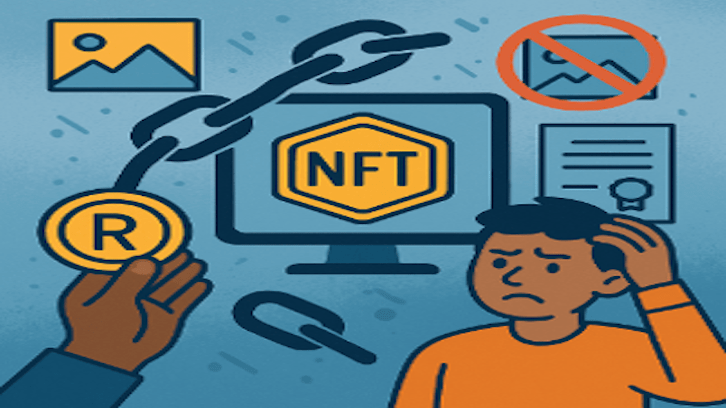
From the blockchain to the courtroom, an explosion of non-fungible tokens (NFTs) has left consumers wondering who really owns the rights to their digital assets. This blog explores the rapid rise of NFTs and the problems that come with the decentralized nature of the technology. In hopes of preventing more confusion surrounding the technology, courts have begun to issue decisions regarding the ability to trademark NFTs.[1] Before this ruling, however, companies were suing other companies, as well as creators, over counterfeit assets and their ability to be trademarked.[2] To maintain consistency across the intellectual property field, state legislatures must step in and establish a new set of standards applicable to non-fungible property.
II. Background
The Rise of NFTs
The first NFT was created in 2013, but several other NFTs were launched in the following years.[3] Although NFTs have been around for over a decade, most users were unaware of them until their rise in popularity in 2021.[4] NFTs allow individuals to own digital artwork that has an artificial scarcity in the digital market.[5] Unlike traditional collectible items such as paintings or trading cards, whose scarcity is determined based on the physical amount of that product, NFTs scarcity is entirely artificial because there is no physical item.[6]
The problem with NFTs is that artists may sometimes include other images in their artwork.[7] This causes issues when artists use previously trademarked images and add them to their “own” NFTs.[8] Given the increasing popularity of NFTs, more and more companies are spending resources to ensure that others do not associate their brands with brands they have not consented to. The prevalence of NFTs has drawn several creators to the courts to resolve the issues.[9]
Trademark Rights on the Blockchain
Trademark rights apply to services, products, and brand names, all of which are prevalent in the virtual world.[10]Trademarks create a way for consumers to distinguish between different items and the brand associated with those items. However, when it comes to the virtual world of the metaverse, some popular brands could be linked to unauthenticated individuals. This uncharted territory allows anyone to create anything, which causes the rules and regulations governing trademarks to become especially challenging.[11]
Although the rules governing trademarking NFTs are not entirely clear, it is not stopping brands from being proactive.[12] As of April 2022, over 4,500 trademark applications had been filed for NFTs in hopes of protecting brand rights.[13] With more applications for trademarks being processed, courts have seen a rise in disputes surrounding the ownership of certain NFTs.
Recent NFT Trademark Disputes
In a recent case, a federal judge for the Southern District of New York ruled that StockX introduced “Vault NFTs” that included trademarks belonging to Nike.[14] Nike filed suit against the competing shoe company because StockX did not obtain permission from Nike to use its trademarked images.[15] Furthermore, Nike worried that customers would be led to think that the images appearing on StockX’s NFTs were associated with Nike.[16] This case shows how easily trademark disputes can escalate in the ever-changing world of NFTs.
Over ten years after the invention of NFTs, courts have witnessed a rapid rise in trademark litigation, and one such case involved a high-end fashion brand, Hermès. In Hermès Int’l v. Rothschild, the court addressed issues that arose when Mason Rothschild began creating and selling NFTs that represented the famous Hermès Birkin bags.[17] Rothschild coined the images as “MetaBirkins” that originally sold for $450, but on the secondary market, they sold between $13,000 and $65,000.[18] Before releasing the Hermès-inspired NFTs, the designer brand sent Rothschild a cease and desist letter.[19] Despite receiving this letter, Rothschild moved to a different digital marketplace and sold the art.[20] As a result, Hermès sued the creator for trademark infringement, and in 2023, a jury found that Rothschild had infringed on the trademark rights of the French luxury brand.[21] The decision not only affirmed the strength of established trademark protections but also raised questions about how courts should address the risks of confusion in the NFT marketplace.
III. Discussion
The Economic Risks
As technology evolves, companies gain more opportunities to make money and grow in business. There is a strong interest in preventing consumer confusion in a commercial setting because sellers can mislead buyers about the nature of products.[22] For example, many consumers believed that Hermès produced the MetaBirkins in collaboration with the iconic fashion brand.[23] Regulations that limit this confusion are important because, without them, consumers are less likely to purchase an NFT if it cannot be guaranteed that the asset being bought is authentic. Although consumers face many risks, creators of NFTs also face risks.
Massive companies, such as Hermès and Nike, have huge brands and reputations they wish to uphold. These companies have made valuable contributions to get their products protected by trademarks, and a third party should not be able to freely sell their images, regardless of whether they are digital.[24] Given the economic risks to both consumers and sellers, the playing field must be leveled to ensure that both parties on each side of the transaction are fairly represented. Moreover, there are significant legal risks in addition to the economic challenges.
The Legal Risks
A major reason for the rise in litigation surrounding NFT trademarks is that creators do not know if traditional trademark laws apply to digital assets the same way they do to tangible ones.[25] Further, NFTs are a part of the global economy, which means they are not limited to only American law.[26] The discrepancy in governance leads to an unreliable set of rules that leads to creators infringing on companies’ NFTs. Other countries have taken action to help clarify the law when it comes to these new technologies.
For example, in China, “internet courts” have been established to help pave the road towards adapting to innovation.[27] These specialized courts allow the judicial system to view technological advancements and the issues arising from them in a specialized forum.[28] The United States could consider taking a similar route, but due to the well-established rules of the United States’ judiciary, this change does not seem likely.[29] Due to the U.S. having both state and federal trademark laws, there is inconsistent guidance for companies and consumers to follow.[30]
In order to combat this problem, the United States should aim to make a standardized form of trademark registration so that consumers know if the digital asset they are buying is a true and accurate representation of the respective company.[31] Although the law often lags behind new technology, courts are having to make conclusions that are representative of evolving technology.
How Courts are Shaping NFT Trademark Law
As seen in prior litigation, courts must step in to help minimize the confusion within the world of NFTs. While it is important to preserve artistic innovation, it is equally important to protect consumers and brand value.[32] Without timely judicial or legislative guidance, creators will continue to believe their works do not violate established trademark laws, and this will lead to more litigation surrounding the developing world of NFTs.
Recently, a federal court recognized that NFTs may qualify for trademark protection, which marks a significant step toward mitigating confusion and provides a framework for intellectual property rights in the digital marketplace.[33] The Ninth Circuit Court of Appeals concluded that an NFT is a “good” as defined under the Lanham Act in Yuga Labs, Inc. v. Ryder Ripps.[34]The opinion in that case creates precedent for other courts to follow, allowing for the development of some kind of commonality in the NFT space. Given that NFTs are a rapidly expanding market, it is important for legal certainty to support investors and innovation. If buyers are unsure of whether an NFT infringes on another product’s trademark, like the MetaBirkins, individuals are less likely to invest in forms of digital property.
Proposed Solution
Although steps have been taken to mitigate the confusion of the developing digital age, further steps must be taken. As it stands, consumers cannot tell if the NFT is authentic or not because there is no common practice to ensure authentication. One way to address this problem is to incorporate a more nuanced rule into existing trademark laws.[35] For example, in Rogers v. Grimaldi,a test was established for courts to determine whether the use of a trademark in an artistic work violates the Lanham Act.[36] The Rogers test provided that a court must first determine whether the work at issue is expressive, and if it is, then the plaintiff must show that the defendant’s use of the trademark either is not artistically relevant to the work or is explicitly misleading to consumers.[37] Currently, most cases involving NFTs are decided on a case-by-case basis, which does not guide consumers.[38]
In comparison, the EU has adopted a universal policy that supports a consistent trademark registration system.[39] Additionally, the UK has taken a legal framework derived from EU trademark law and proactively issued guidance on NFTs.[40] For example, the UK has determined how to classify NFTs compared to physical items, as well as provided warnings for creators to not rely on regulations that apply to physical goods when dealing with digital items.[41]
As it currently stands, courts have not been consistent in their rulings, which has left creators confused. The United States should adopt a policy similar to the UK and take existing trademark precedent, such as the Rogers Test, and tweak the test to be representative of digital items. It is important that states create legal frameworks, such as those seen in other countries, to minimize the confusion. This approach would give creators a better sense of what they are allowed to use when creating their NFTs, and brands will have a better understanding of what to look out for in NFTs to ensure their product is not being infringed upon.
IV. Conclusion
With new technology comes new challenges, especially in the legal field. The creation of NFTs has enabled creators to express their visions and ideas in a way that was previously inaccessible. However, given the confusion surrounding the recent increase in demand for digital assets, there are both economic and legal risks that come with these types of assets. As a result, the United States must adopt a uniform set of rules that can help eliminate the confusion among digital creators and consumers.
[1] Ashley Justice, It’s Not Monkey Business: NFTs Can be Trademarked, Nat’l L. Rev. (July 31, 2025), https://natlawreview.com/article/its-not-monkey-business-nfts-can-be-trademarked [https://perma.cc/9AGB-GXEV].
[2] Blake Brittain, Nike Settles Lawsuit Against StockX over NFTs, Counterfeiting, Reuters (Aug. 29, 2025), https://www.reuters.com/legal/litigation/nike-settles-lawsuit-against-stockx-over-nfts-counterfeiting-2025-08-29/ [https://perma.cc/N855-GQTW].
[3] Jolene Creighton, NFT Timeline, The Beginnings and History of NFTs, NFT Now (Dec. 15, 2022), https://nftnow.com/guides/nft-timeline-the-beginnings-and-history-of-nfts/ [https://perma.cc/7VAJ-M4JV].
[4] Id.
[5] Andrew Michaels, Confusion in Trademarked NFTs, Stan. J. of Blockchain L. & Pol’y. 1, 2 (2024).
[6] Peng Xie, Artificial scarcity design heuristics for digital collecting: Evidence from the non-fungible token market, Info. & Mgmt. J. (2025), https://www.sciencedirect.com/science/article/pii/S0378720625000126?via%3Dihub [https://perma.cc/WX8G-BY6C].
[7] Id. at 2.
[8] Id.; see Nike, Inc. v. StockX LLC, No. 22-CV-0983 (VEC), 2024 WL 3456781(S.D.N.Y. July 10, 2024).
[9] Michaels, supra note 5, at 8.
[10] WooJung Jon & Sung-Pil Park, Comparative analysis of trademarked protection in the metaverse and registration of virtual goods and NFTs, Comput. L. & Sec. Rev. (2025).
[11] Id.
[12] Brittany Kaplan & Brenna Legaard, Applying US Trademark Law to NFTs, Bloomberg L. (July 2022), https://www.bloomberglaw.com/external/document/XFJLDKOK000000/trademarks-professional-perspective-applying-us-trademark-law-to [https://perma.cc/Y2A9-CU9G].
[13] Id.
[14] Id.
[15] Id.
[16] Brittain, supra note 2.
[17] Harper Johnson, Case Review: Hermès International v Rothschild, Ctr. for Art L. (May 7, 2024), https://itsartlaw.org/case-review/case-review-hermes-v-rothschild/#:~:text=Decision,speech%20under%20the%20First%20Amendment [https://perma.cc/R2JL-BCDU].
[18] Id.
[19] Id.
[20] Id.
[21] Id.
[22] Michelle Gery, Understanding the MetaBirkin: Trademark Law and an Appropriate Legal Standard for NFTs, 47 B.U. PUB. INT. L.J. 619, 632 (2024).
[23] Id.
[24] Id.
[25] Id. at 631.
[26] Hanna Esserman, Marking the Metaverse: The Implications of NFTs on Trademark Law, 31 J. INTELL. PROP. L. 67, 71 (2024).
[27] Id.
[28] Id.
[29] Id.
[30] Sara Sachs, Trademark Infringement: The Likelihood of Confusion of NFTs in the US and EU, Brook. J. Int’l. L. 331, 356 (2023).
[31] Id. at 355.
[32] Jon & Park, supra note 10.
[33] Justice, supra note 1.
[34] Id.
[35] Jon & Park, supra note 10.
[36] Anthony Dreyer et al., Supreme Court Sharply Limits Applicability of Rogers v Grimaldi Test for Trademark Infringement, Skadden, Arps, Slate, Meagher & Flom LLP & Affiliates (June 8, 2023), https://www.skadden.com/insights/publications/2023/06/supreme-court-sharply-limits-applicability [https://perma.cc/52B2-659S].
[37] Id.
[38] Jon & Park, supra note 10.
[39] Sachs, supra note 30 at 355.
[40] Jon & Park, supra note 10.
[41] Id.


Leave a Reply