Wil Schuehler, Associate Member 2025-2026
Intellectual Property and Computer Law Journal
I. Introduction
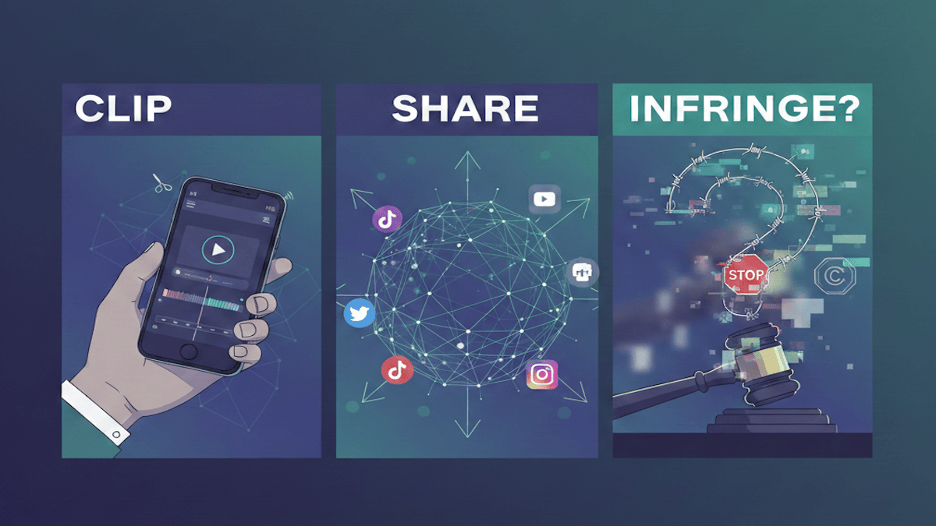
Every day, millions of users clip, repost, and remix videos across TikTok and Instagram without a second thought, unaware that behind each upload sits a legal framework that can transform what feels like a casual share into an act of copyright infringement.[1] This blog explores the inner workings of social media clipping and its legal implications. Part II examines the general copyright legal framework, the fair use defense, and a landmark court decision on fair use. Part III discusses how platforms police copyright infringement, the over-removal of works, and possible reforms. Part IV concludes by recognizing the need for reform within the field and provides a solution.
II. Background: Legal Landscape
Copyright Basics
Social media platforms such as TikTok and Instagram have a combined total of 4.99 billion monthly active users.[2] TikTok alone removed approximately 204.53 million videos during the third quarter of 2025, 91% of which were removed through automated systems. .[3] However, typical social media users are unaware that this process is driven by copyright law. Copyright is defined as a type of intellectual property that protects original works of authorship as an author transforms the work into a tangible medium of expression.[4]. Works are deemed original when they are created by a human author independently with a certain minimal degree of creativity.[5] A work is considered fixed when it is captured in a sufficiently permanent medium where that work can be perceived, reproduced, or communicated for more than a transitory duration.[6] Once an author creates an original work, such as a video, and fixes it in a tangible medium by posting it, they become the copyright owner.[7] A copyright owner is granted exclusive rights for seventy years after their death, including the rights to reproduce the work in copies, prepare derivate works based upon the work, distribute copies of the work by sale or lease, perform the work publicly, and display the work publicly.[8] But what happens when a person who is not the copyright owner wishes to use the work?
Under the fair use doctrine outlined in 17 U.S.C. § 107, non-copyright owners are permitted the unlicensed use of copy-righted works in certain circumstances.[9] Section 107 specifies four non-exhaustive factors in evaluating questions of fair use.[10] First is the purpose and character of the use, including whether the use is of a commercial nature or is for nonprofit education purposes.[11] This first factor is often referred to as “transformative” use.[12] Second is the nature of the copyrighted work, as the use of a highly creative work is less likely to qualify as fair use.[13] The third factor is the amount and substantiveness of the portion used in relation to the copyrighted work as a whole.[14] The fourth and final factor is the effect of the use upon the potential market for or value of the copyrighted work.[15]
Common instances of successful fair use defenses can be seen when the copyrighted work is used for criticism, commentary, news reporting, teaching, scholarship, or research.[16] Questions of fair use are determined on a case-by-case basis and are not limited to the four factors above, nor is any single factor dispositive..[17]
One significant court decision addressing the fair use doctrine was the 2023 U.S. Supreme Court decision in Andy Warhol Found. for the Visual Arts, Inc. v. Goldsmith, 598 U.S. 508 (2023). This case held that the first factor under the doctrine must inquire into if the “alleged infringement has a further purpose or different character, which is a matter of degree, and the degree of difference must be weighed against other considerations, like commercialism.”[18] In sum, this decision narrowed the first factor of the fair use doctrine by emphasizing that a secondary work’s transformative purpose must be weighed against its commercial use, specifically when the secondary work shares the same general purpose as the original.
Platform Architecture and Rules
Another layer of regulation arises under Section 512 of the Digital Millennium Copyright Act (DMCA), which allows platforms to qualify for safe harbor from copyright liability.[19] To qualify, platforms must adopt and implement a policy for terminating accounts of repeat infringers, inform users of that policy, accommodate standard technical measures used by copyright owners to identify and protect their works, and designate agents to receive takedown notices from copyright owners and recording those agents with the U.S. Copyright Office.[20]
In addition to the requirements set forth under the DMCA, platforms utilize automated content identification (ID) systems to detect copyright infringement.[21] These ID systems work by creating unique fingerprints for copyrighted material and then comparing those fingerprints to uploaded content to identify matches or altered content.[22] They also employ machine learning where AI algorithms detect manipulated content in order to distinguish between fair use and infringement.[23] For supplemental accuracy, the platforms will review metadata, editing history, and user behavior.[24] Both Instagram and TikTok analyze content automatically before it goes live.[25] Users are immediately notified if a copyright issue is flagged and gives users the chance to avoid accidental violations.[26] Moreover, Instagram and TikTok provide tools that allow users to report alleged copyright infringement with supporting documentation.[27] While the legal landscape and platform practices may seem adequate on paper, in practice, multiple problems appear.
III. Discussion
User Perspective: When is Clipping Legal?
One major criticism of the current framework from the user’s perspective is the uncertainty of when or how a post infringes on copyrighted work.[28] The four-factor fair use analysis is inherently fact- and context-specific, leaving users who clip and share content with no clear way to determine if their use satisfied these factors. [29] Furthermore, because platforms like TikTok and Instagram have such a vast amount of users and content, determinations of infringement is left primarily in the hands of automated content recognition systems.[30] This practice raises some serious questions: do these AI detection systems analyzing the four fair use factors, and how often do they misidentify lawful uses as infringements?
Alarmingly, platform’s automated detection systems do not consider the fair use defense when analyzing potential copyright violations.[31] Once the automated system detects a fingerprint match, the content is muted, blocked, filtered, or removed.[32] This is particularly troubling because the user’s content may qualify for fair use.
Moreover, these automatic detection systems can and often do get these determinations wrong.[33] When false positives occur and a user’s content is removed, there is a negative impact on users’ innovation and creativity.[34]
Consider a common scenario: a creator clips the last thirty-seconds of an NFL broadcast highlighting and criticizing a missed or controversial call. The criticism is the purpose, and the video is the hook. Under the first fair use factor, the creator arguably engages in a transformative use by using the broad cast to convey criticism about the call. Under the second factor, NFL broadcast is factual and not as creative as a motion picture.[35] Under the third factor, the portion used in relation to the entire broadcast is relatively minimal. Under the fourth factor, it is unlikely that viewers would consider the clip as a substitute for an NFL+ or Sunday Ticket subscription. Considering those facts, the fair use doctrine would likely apply.
However, if the creator runs advertisements on his page or monetizes the video, the analysis shifts under Warhol.[36] Post-Warhol, a court will have to balance the commercial use of the clip against its transformative purpose.[37] This balancing test leaves creators unsure as to whether their actions constitute fair use, and the automated system will remove the content without ever engaging in this analysis.[38]
Platform Perspective
From the platform’s perspective, there is strong incentive to remove infringing content, but there is little deterrence to stop over-removal.[39] The DMCA’s safe harbor provisions primarily drive this disparity.[40] To qualify for safe harbor protection, platforms must act promptly to takedown notice, yet there is no statutory requirement for platforms to verify infringement has occurred.[41] Platforms are generally not liable for incorrect takedowns.[42] As a result, they err on the side of over-removal to ensure their safe harbor status..[43]
After the content has been deemed an infringement and the alleged violator is notified, users have minimal meaningful options for redress. The most common way to dispute a copyright infringement claim is to file a counter-notification with the platform, asserting fair use, evidence of original creation, or misidentification.[44] This process typically takes up to two weeks, and is poorly understood. [45] If a user files a false counter-notice, the user may be exposed to account penalties, legal liability, permanent removal of content, and heightened scrutiny of future uploads.[46] Considering the pitfalls of the current regime of the DMCA and automated detections systems, it is clear improvements are necessary.
Possible Reforms
First, greater transparency from platforms could result in increased accountability and promote fairer results.[47] Platforms should disclose how their automated detection systems operate, including the rate of false positives and the factors considered during detection.[48] This will allow users and regulators to identify shortcomings in order to improve the current system.
Second, with the advancements in AI, platforms and copyright owners can implement fair use analysis when reviewing potential infringement claims.[49] This could lead to more accurate infringement claims, prevent over-removal, and promote innovative works.
However, this approach would only be as effective as the driving algorithms, and platforms would have to invest in development.[50] Further, platforms should share in the potential liability of inaccurate takedowns to curb the incentivized nature of excessive removal.
IV. Conclusion
The current framework governing video clipping on social media platforms leaves users vulnerable to unpredictable copyright infringement claims. Greater platform transparency, incorporation of fair use analysis in automated systems, and meaningful liability for inadequate takedown measures could promote lawful expression online.
[1] How Many Videos Are Uploaded Every Day: Mind-Blowing Platform Statistics, (Jan. 30, 2025), https://socialrails.com/blog/how-many-videos-uploaded-daily-statistics [https://perma.cc/7QQE-9N3R].
[2] Thuy D., Most Popular Social Networks Worldwide as of February 2025, by Number of Monthly Active Users, Statista (Nov. 19, 2025), https://www.statista.com/statistics/272014/global-social-networks-ranked-by-number-of-users/ [https://perma.cc/3KVC-YXJE].
[3] Thuy D., Number of TikTok Videos Removed From the Platform From 3rd Quarter 2020 to 3rd Quarter 2025, Statista (Jan. 15, 2026), https://www.statista.com/statistics/1300031/tiktok-videos-removed/ [https://perma.cc/5ZD8-KG4E].
[4] U.S. Copyright Office, What is Copyright?, (last visited Febr. 26, 2026), https://www.copyright.gov/what-is-copyright/ [https://perma.cc/JX7U-WQZG].
[5] Id.
[6] Id.
[7] Id.
[8] Id.
[9] U.S. Copyright Office, Fair Use Index, (last visited Feb. 26, 2026), https://www.copyright.gov/fair-use/ [https://perma.cc/7JLD-HA6D].
[10] Id.
[11] Id.
[12] Kyle Kroll, Transformation and New Purpose: How Courts Are Applying Fair Use After Goldsmith v. Warhol, Winthtop & Weinstine (Apr. 22, 2025) https://winthrop.com/bold-perspectives/transformation-and-new-purpose-how-courts-are-applying-fair-use-after-goldsmith-v-warhol/ [https://perma.cc/7V68-7WLS].
[13] U.S. Copyright Office, Fair Use Index, supra note 9.
[14] Id.
[15] Id.
[16] Id.
[17] Id.
[18] Andy Warhol Found. for the Visual Arts, Inc. v. Goldsmith, 598 U.S. 508, 525 (2023).
[19] U.S. Copyright Office, Section 512 of Title 17: Resources on Online Service Provider Safe Harbors and Notice-and-Takedown System, (May 21, 2020), https://www.copyright.gov/512/ [https://perma.cc/RPK4-K7C9].
[20] Copyright Alliance, DMCA Safe Harbor, (last visited February 26, 2026), https://copyrightalliance.org/education/copyright-law-explained/the-digital-millennium-copyright-act-dmca/dmca-safe-harbor/ [https://perma.cc/R5Q6-DNDJ].
[21] Detecting-AI, How Social Media Detects Copyright Violations, (May 12, 2025), https://detecting-ai.com/blog/how-social-media-detects-copyright-violations [https://perma.cc/7L7L-GZ3H].
[22] Id.
[23] Id.
[24] Id.
[25] Id.
[26] Detecting-AI, How Social Media Detects Copyright Violations, supra note 21; see also WebyCopyrightChecker, TikTok Copyright Violations: Complete Legal Protection Guide 2025, (Mar. 27, 2025), https://www.webcopyrightchecker.com/blog/tiktok-copyright-violations [https://perma.cc/8W84-KUU2].
[27] Detecting-AI, How Social Media Detects Copyright Violations, supra note 21.
[28] Michelle Davis, Brands Beware: Copyright Detection is Catching up – Here’s What You Need to Know to Stay Safe, JD Supra (Dec.1, 2025), https://www.jdsupra.com/legalnews/brands-beware-copyright-detection-is-853185 [https://perma.cc/9S53-NPRR]; see also The Doyle Report, Avoiding Copyright Infringement on Social: Fair Use and Best Practices, (Oct. 24, 2003), https://thedoylereport.com/avoiding-copyright-infringement-on-social-fair-use-and-best-practices [https://perma.cc/CK4T-UBUZ].
[29] U.S. Copyright Office, What is a Copyright?, supra note 9.
[30] Detecting-AI, How Social Media Detects Copyright Violations, supra note 21.
[31] Vaulted IP, Understanding Fair Use in User-Generated Videos Within Intellectual Property Law, (last visited Feb. 26, 2026), https://vaultedip.com/fair-use-and-user-generated-videos/ [https://perma.cc/5MXL-ZN5U]; see also Lina Montes, Copyright Enforcement and Fair Use in the Digital World, (Dec. 17, 2021), https://www.cs.yale.edu/homes/jf/monteslina_86517_5817819_final_paper.pdf [https://perma.cc/AG7G-DP89].
[32] WebCopyrightChecker, supra note 26.
[33] Toni Lester & Dessislava Pachamanova, The Dilemma of False Positives: Making Content ID Algorithms More Conducive to Fostering Innovative Fair Use in Music Creation, 24 UCLA Entertainment L. Rev. 51, (2017) https://escholarship.org/uc/item/1x38s0hj [https://perma.cc/3GX9-AKF5].
[34] Id; see also Lina Montes, Copyright Enforcement and Fair Use in the Digital World, supra note 31.
[35] Sony Corp. of Am. v. Universal City Studios, Inc., 464 U.S. 417, 455 n.40 (1984).
[36] Warhol, 598 U.S. 508, supra note 18.
[37] Id.
[38] Lester & Pachamanova, False Positives, supra note 33.
[39] Cory Doctorow, Copyright Takedowns Are a Cautionary Tale That Few Are Heeding, Medium (Jun. 27, 2024), https://doctorow.medium.com/https-pluralistic-net-2024-06-27-nuke-first-ask-questions-never-faf8efc951c1 [perma error].
[40] Id.
[41] Bao Tran, Top 5 Mistakes Platforms Make When Responding to DMCA Notices, PatentPC (Feb. 1, 2026), https://patentpc.com/blog/top-5-mistakes-platforms-make-when-responding-to-dmca-notices [https://perma.cc/L3M4-TG6A].
[42] U.S. Copyright Office, Section 512 of Title 17 A Report of the Register of Copyrights, 25, (May 2020), https://www.copyright.gov/policy/section512/section-512-full-report.pdf [https://perma.cc/HPF4-6RE9].
[43] Id.
[44] TikTok, Intellectual Property Policy, (last visited Feb. 26, 2026), https://law-enforcement-tiktok-uscan.zendesk.com/hc/en-us/articles/6025567145371-Intellectual-property-policy [https://perma.cc/9DBR-NAQM]; see also Detecting-AI, How Social Media Detects Copyright Violations, supra note 21.
[45] Detecting-AI, How Social Media Detects Copyright Violations, supra note 21.
[46] Id; see also Jonathan Bailey, 7 Common Questions About DMCA Counter-Notices, (June 3, 2010), https://www.plagiarismtoday.com/2010/06/03/7-common-questions-about-dmca-counter-notices/ [perma error].
[47] Lester & Pachamanova, False Positives, supra note 33.
[48] Id.
[49] Id.
[50] Id.


Leave a Reply