Andrew Bridenstine, Associate Member 2025-2026
Intellectual Property and Computer Law Journal
I. Introduction
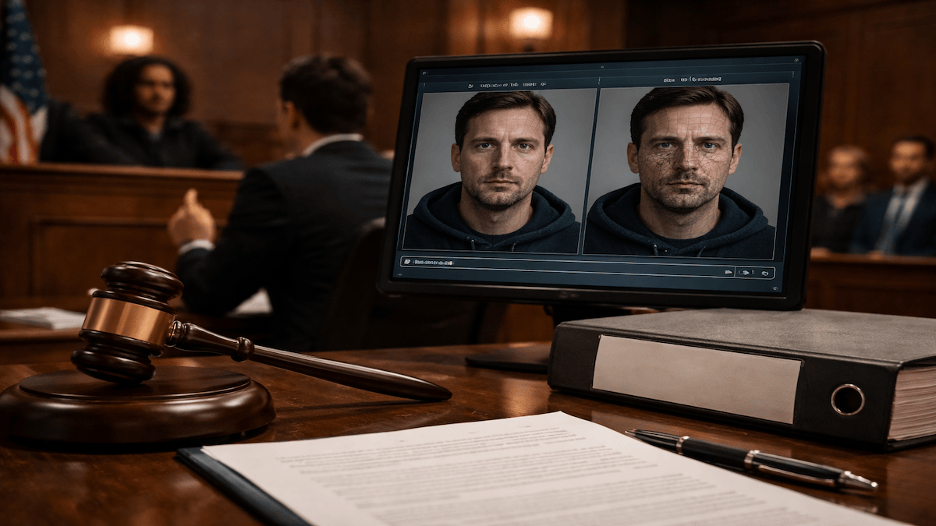
Generative AI has allowed people to alter videos, photos, and other pieces of evidence that have been admitted into evidence during court proceedings. Due to this, legislatures have proposed new evidence rules regarding AI-generated evidence.
This blog explores the background of deepfakes and how individuals are using them to confuse judges, jurors, and attorneys. Deepfakes have already been used in court, and this blog will explain how the courts have responded to digitally fabricated evidence. Lawmakers are growing increasingly concerned about the use of deepfakes in the legal system, prompting the proposal of a new evidentiary rule aimed at mitigating their impact. Lastly, this blog will argue that this rule must be adopted, and judges must be trained to identify and address deepfakes during proceedings.
II. Background
Types of AI Evidence
To understand the world of artificial evidence (AI) within the legal system, it is important to distinguish between the two main categories of AI evidence.[1] Acknowledged AI-generated evidence is openly disclosed as created or modified by AI.[2] Examples of this include accident reconstruction videos or expert analysis tools. [3] The second form is unacknowledged AI-generated evidence, which is evidence that is presented as authentic when it is actually AI-generated or manipulated.[4] The latter category of evidence is where deepfakes operate.
What are Deepfakes?
The rapid advancement of AI has generated both amazing innovations and unforeseen legal risks, including the growing number of deepfakes in the courtroom.[5] Deepfakes are AI-generated images, audio recordings, and videos that mimic real people.[6] They are very easy to create and pose significant problems for courts when handling video and image evidence.[7] Given the rapid technological advancements, judges and lawyers are faced with more complications surrounding the admissibility of certain evidence.[8]
Complexities Surrounding the Use of Deepfakes
Lawyers and judges are faced with continual challenges surrounding an evolving legal system, but the issues that stem from the rise in AI deepfakes are more prevalent than ever. Deepfakes complicate courts’ ability to assess the authenticity of digital evidence, leading to increased litigation costs as parties must retain additional experts to identify and rebut fabricated media. [9],[10] For individuals who are already financially constrained, these added costs may deter them from pursuing litigation altogether.[11]
Additionally, deepfakes pose a serious risk of juror skepticism. Jurors often lack the technical expertise to differentiate between authentic and manipulated evidence, which increases the probability of prejudicial decisions.[12] Evidence once regarded as highly reliable can now be easily manipulated and can undermine one’s case theory.[13] For example, an individual could fabricate a vehicle title and submit it to the county clerk, who would record it as an official document.[14] The risk of misuse is substantial, creating a need for reform before the current laws are deemed insufficient.
Although artificial intelligence has existed for years, the problems caused by deepfakes within the legal system are relatively new, there have already been reported instances of deepfakes disrupting court proceedings.[15]
Cases Where Deepfakes Have Been Used
Currently, the issue of AI-manipulated evidence arises in cases where a party acts as their own legal representative, also referred to as acting pro se.[16] In Medones v. Cushman & Wakefield, a California judge reviewed the footage of a suspicious video and discovered it had strange cuts and repeated mannerisms.[17] Here, the pro se plaintiffs submitted the video evidence as authentic when, in reality, it was entirely AI-generated.[18] In a separate instance in Florida, a woman was detained for two days after her ex-boyfriend fabricated text messages using AI.[19] These falsified text messages resulted in her arrest for allegedly violating a protective order.[20]
Although there are no confirmed cases of lawyers knowingly submitting AI-generated evidence, there have been cases in which lawyers cited fake cases produced by AI.[21] Therefore, education among attorneys and judges will be critical to identifying fabricated evidence. Moreover, lawmakers must consider adapting updated evidentiary frameworks to address the use of AI-generated media.
III. Discussion
Deepfake Risk Mitigation: Practices and Legal Standards
In light of recent technological developments increasing the likelihood of deepfakes in the courtroom, judges and lawyers must adopt practices to help mitigate the risk of misuse.[22] Under the current evidentiary rules, the burden will be put on litigants by the judges to prove the legitimacy of their evidence, as opposed to making the judge decide the validity of the evidence in question.[23] However, current rules regarding evidence may not always be compatible with AI-generated evidence.[24] Traditional evidentiary authentication rules, such as Rules 901 and 902, may inadvertently allow fabricated evidence to be admitted.[25] One reason is that Rule 901 sets a relatively low threshold for authentication.[26] Current rules do not require AI-generated evidence to meet sufficiently high standards of reliability and authenticity before it is presented to the court.[27]
Due to the possibility of fabricated evidence, attorneys should recognize patterns that raise concerns.[28] For example, attorneys must look for pieces of evidence that appear unusually favorable.[29] Another potential safeguard is to closely evaluate all exhibits, especially those with audio, video, or picture formats, because these are the most likely to have been artificially manipulated.[30] Although attorneys should look for possible AI-generated evidence, the technical sophistication of generative AI makes this very difficult.[31] As a result, policymakers have begun to develop proposed solutions.
New Proposed Rule of Evidence
Existing evidentiary frameworks are insufficient to address the risks posed by AI-generated evidence, which can evade traditional authentication standards. To address this gap, Proposed Rule 707 would treat machine-generated evidence as subject to the same reliability standards as those governing expert testimony.[32] Expert testimony is governed by Rule 702, and to get evidence admitted under this rule, it must pass the four requirements under subsections (a)-(d).[33] These requirements include demonstrating that the evidence is based on sufficient data, produced through reliable principles and methods, and that those principles were reliably applied to the case.[34]
Rule 707 emphasizes that evidence produced by AI must demonstrate reliability equivalent to that of a human expert.[35] With this new rule, courts will have more guidance on upholding strict standards of reliability, whether evidence is generated by a person or a machine.[36]
Although many are optimistic about this proposed legislation, some commentators are skeptical.[37] One of their main concerns is that the phrase “machine-generated evidence” is not clearly defined.[38] Without proper definitions, the terms create vagueness and ambiguity regarding the rule’s scope.[39] The Federal Courts Committee recommends that the language be changed from “machine-generated evidence” to “machine-generated inferential evidence.”[40] This change will remove the need to omit the terminology “output of simple scientific instruments” from the proposed rule.[41]
Although the committee approved the rule on June 10, 2025, this is only the first step, as it is currently open for public commentary.[42] This rule must be implemented to proactively address risks associated with deepfakes in the courtroom.
Rule 707 is Necessary to Support Judicial Legitimacy
If this new evidentiary rule is not implemented, litigants will lack meaningful notice of the governing standards, and courts will be forced to adjudicate admissibility on a case-by-case basis, resulting in inconsistent and unpredictable outcomes.[43] Rule 707 would prevent parties from evading the reliability requirements of Rule 702 and create a uniform standard across the legal system.[44] Additionally, it would reduce the risk of confusion, ambiguity, and inconsistency in applying existing rules governing the admissibility of similar evidence.[45] Lastly, Rule 707 would integrate seamlessly with existing authentication rules by ensuring that certifications used to self-authenticate AI-generated evidence also satisfy the reliability requirement set out in Rule 702.[46] Although there is skepticism surrounding Rule 707, without it, courts will have no standard to follow when dealing with AI-generated evidence.[47] Rule 707 must be adopted to help prevent the misuse of artificially generated evidence within the legal system.
IV. Conclusion
Artificial intelligence has helped industries become more efficient by increasing production and decreasing the number of people necessary to produce the goods. However, with this change, artificial images, videos, and other data are manipulated to make them seem authentic.[48] As a result, the misuse of these deepfakes in the courtroom is rapidly rising and must be regulated. This problem has been exemplified with multiple reports of self-represented litigants attempting to admit deepfakes into evidence. Therefore, Rule 707 has been proposed to help curb the ambiguity and set a uniform standard for consistent outcomes across the courts.
Rule 707 will help lawyers and judges by providing a standardized framework for how AI evidence should be handled. Additionally, the proposed rule will make it more difficult to get fraudulent evidence admitted, as it will have to meet heightened standards.[49] As artificial intelligence technology continues to advance, the legal system must evolve alongside it to ensure that the integrity of the judicial process is preserved.
[1] Natalie Runyon, Deepfakes on trial: How judges are navigating AI evidence authentication, Thomson Reuters, (May 8, 2025), https://www.thomsonreuters.com/en-us/posts/ai-in-courts/deepfakes-evidence-authentication/ [https://perma.cc/EJ5W-2GXE].
[2] Id.
[3] Id.
[4] Id.
[5] Harry Weddell, Deepfakes in the Courtroom: How the Legal System Is Responding to the Threat of AI-Generated Evidence, McManis Faulkner, (Jan. 29, 2026), https://www.mcmanislaw.com/blog/2026/deepfakes-in-the-courtroom-how-the-legal-system-is-responding-to-the-threat-of-ai-generated-evidence/ [https://perma.cc/G5TR-MD66].
[6] Id.
[7] George Bellas, Deepfakes in the Courtroom: Problems and Solutions, Illinois State Bar Association, (Mar. 2025), https://www.isba.org/sections/ai/newsletter/2025/03/deepfakesinthecourtroomproblemsandsolutions [https://perma.cc/33NU-6WZQ].
[8] Id. at ¶ 9.
[9] Id. at ¶ 11.
[10] Id.
[11] Id.
[12] Id. at ¶ 16.
[13] Connor Heaton et al., AI-generated evidence is a threat to public trust in the courts, Nat’l Ctr. For State Cts., (Feb. 24, 2026), https://www.ncsc.org/resources-courts/ai-generated-evidence-threat-public-trust-courts [https://perma.cc/V6MP-7N2P].
[14] Id.
[15] Lisa Fletcher, Courts facing growing threat from AI-generated deepfakes as experts warn safeguards lag, 12 News, (Dec. 18, 2025), https://cbs12.com/news/spotlight-on-america/courts-face-growing-threat-from-ai-generated-deepfakes-as-experts-warn-safeguards-lag-california-evidence-law-judges-plaintiffs-testimony-security [https://perma.cc/8XF6-ED29].
[16] Heaton et al., supra note 13.
[17] Id. at ¶ 1.
[18] Id.
[19] Id. at ¶ 4.
[20] Id.
[21] Daniel Wu, Lawyers using AI keep citing fake cases in court. Judges aren’t happy, The Washington Post, (Jun. 3, 2025), https://www.washingtonpost.com/nation/2025/06/03/attorneys-court-ai-hallucinations-judges/ [https://perma.cc/PV7B-NPF9].
[22] Chuck Kellner, The End of Reality? How to combat deepfakes in our legal system, National Association for Presiding Judges and Court Executive Officers, (Dec. 26, 2025), https://napco4courtleaders.org/2025/12/the-end-of-reality-how-to-combat-deepfakes-in-our-legal-system/ [https://perma.cc/EJ5W-S85H].
[23] Id.
[24] Natalie Runyon, AI evidence in jury trial: Navigating the new frontier of justice, Thomson Reuters, (Oct. 6, 2025), https://www.thomsonreuters.com/en-us/posts/ai-in-courts/ai-evidence-trials/ [https://perma.cc/EZ9E-SRZE].
[25] Id.
[26] Harshwinder Kaur Badhesha, Addressing Challenges of Deepfakes and AI-Generated Evidence, Taft Law, (Sep. 17, 2024), https://www.taftlaw.com/news-events/law-bulletins/addressing-challenges-of-deepfakes-ai-generated-evidence/ [https://perma.cc/QPT5-S4GA].
[27] Id.
[28] Michael Maschke et al., Are Lawyers Ready for Deepfakes in Courts, American Bar Ass’n., (Mar. 6, 2026), https://www.americanbar.org/groups/law_practice/resources/law-practice-magazine/2026/march-april-2026/lawyers-ready-for-deepfakes-in-court/ [https://perma.cc/5PD2-FVE3].
[29] Kellner, supra note 22.
[30] Id.
[31] Runyon, supra note 24.
[32] Heaton et al., supra note 13.
[33] Meyers Nave, Proposed New Federal Rule Regarding AI-Generated Evidence, Meyers Nave, (Feb. 18, 2026), https://www.meyersnave.com/proposed-new-federal-rule-regarding-ai-generated-evidence/ [https://perma.cc/K9ZF-2ULL].
[34] Emma Howard, AI in the Courtroom: How Proposed Rule 707 Could Shape Evidence Standards, Steptoe, (Jan. 28, 2026), https://www.steptoe.com/en/news-publications/the-mother-court-blog/ai-in-the-courtroom-how-proposed-rule-707-could-shape-evidence-standards.html [https://perma.cc/RV4F-3ENQ].
[35] Nave, supra note 33.
[36] Frank Young, Proposed New FRE 707, University of Illinois Chicago, (Jul. 3, 2025), https://library.law.uic.edu/news-stories/proposed-new-fre-707/ [https://perma.cc/75KN-9BTE].
[37] Johnathan New, Comments on Proposed Federal Rule of Evidence 707 and Amendments to Rule 609, N.Y.C. Bar Ass’n, (Feb. 13, 2026), https://www.nycbar.org/reports/comments-on-proposed-federal-rule-of-evidence-707-and-amendments-to-rule-609/ [https://perma.cc/2WMD-89PX].
[38] Id.
[39] Id.
[40] Id.
[41] Id.
[42] Kristen Libonati, Man vs. Machine: Proposed Federal Evidence 707 Aims to Combat Artificial Intelligence Usage in the Courtroom Through Expert Testimony Standards, Villanova Law Review, (Sep. 22, 2025), https://www.villanovalawreview.com/post/3458-man-vs-machine-proposed-federal-rule-of-evidence-707-aims-to-combat-artificial-intelligence-usage-in-the-courtroom-through-expert-testimony-standard [https://perma.cc/F6P4-JD3R].
[43] Alexa Perez, Admitting AI-Generated Evidence: Proposed Federal Rule of Evidence 707, Iowa Bar Ass’n, (Dec. 1, 2025), https://www.iowabar.org/?pg=IowaLawyerMagazine&pubAction=viewIssue&pubIssueID=62363&pubIssueItemID=408831 [https://perma.cc/R8LW-67WK].
[44] Libonati, supra note 42.
[45] Id.
[46] Doug Austin, Proposed Federal Rule of Evidence 707, a Supporting Letter from Grossman and Grimm: Artificial Intelligence Trends, (Jan. 26, 2026), https://ediscoverytoday.com/2026/01/26/proposed-federal-rule-of-evidence-707-a-supporting-letter-from-grossman-and-grimm-artificial-intelligence-trends/ [https://perma.cc/A6BS-ZPBN].
[47] Id.
[48] Science & Tech Spotlight: Combating Deepfakes, U.S. Government Accountability Office, (Mar. 11, 2024), https://www.gao.gov/products/gao-24-107292 [https://perma.cc/Y7SG-DUCF].
[49] Howard, supra note 34.


Leave a Reply